|
PRAYERS ACTIONS.
1)
ADHAN AND IQAMA
2)
ADHAN
BEFORE PRAYER
3)
STEPS OF
PRAYERS
4)
OMITTING
OPENING TAKBEER MAKES PRAYER INVALID
5)
SAYING SAMI'ALLAH U
LIMAN HAMIDAH
6)
SAYING
AL-SALAAMU 'ALAYKA AYYHU'L-NABIYYU
7)
PROSTRATION ON ALL SEVEN PARTS OF THE BODY
8)
FEET POSITION WHEN
PROSTRATING
9)
PRAYING WEARING SHOES
10) RAISING HANDS IN SALAT (RAFA UDAIN)
11) MOVING FINGER
DURING TASHUD
12)
SUJJUD AS-SAHW
13) GARMENT HANGING BELOW ANKLES
14) MEN
PRAYING IN HALF-SLEEVES AND BARE-HEADED
15) OVERSTEPPING
THE MARK IN MAKING DUAA
16)
STARTING & ENDING DUAA WITH BLESSING ON PROPHET
17) DUA:
RAISING HANDS FOR DUA & WIPING FACE AFTER PRAYER
18)
Things Which Invalidate
the Prayer
19) CHANGING
PLACES AFTER A CONGREGATION PRAYER
20) INVALIDATION
OF ONE'S PRAYER IF AN ADULT WOMAN WALKS IN FRONT
21) ANSWERING
TV SALAAM
22) offering
fajr sunnah when fard prayer started
23) running
for joining congregation prayer
24) imam
sitting after leading prayer
25) facing
qibla problem
26) HOLDING
SECOND CONGREGATIONAL PRAYER IN THE MOSQUE
27) IMAM
WUDOO BROKEN'
28) MINIMUM
PERSONS IN CONGREGATION
29) DHIKR
30)
WHAT
SHOULD A NON-ARAB DO FOR THE ADHKAAR IN SALAAH?
31)
WHAT
ABOUT CORRECTING IMAM MISTAKES IN RECITATION?
32)
PRAYER INTENTION
33)
THE REWARD FOR THE MUEZZIN AND THE ONE WHO GIVES IQAAMAH
34)
ACCEPTANCE
CRITERIA OF DUAA
35)
QURANIC DUAAYAIN
36)
AZAN AND IQAMA
37)
VIDEOS
TOP

Question:
Was addition to the
call to prayer for Fajr was made in the words "As-salato khairun mina al
nawm" approved or not? What is the evidence for the "Hanafi" iqama?
Answer: Praise be to Allah.
It was made at the time of the Prophet. It is
true that when the adhan, i.e. call to prayer, was learned, it did not
include such words which means "Prayer is better than sleep;" The words
of the adhan were taught to Bilal and he started practicing them. The
following day, when he made the call to Fajr prayer, he added these
words. The Prophet smiled and approved. Since then, these words are part
of the call to Fajr prayer. As you see, the Prophet has sanctioned this
addition which takes effect as a part of the adhan.
In a
hadith related by Imam Abu Dawud in his Sunan, Mu'adh Ibn jabal
(may Allah be please with him) says that after the angel called out the
adhan, he called out the iqama in the same way, except
that he added "Qad qamat al-salah" twice after "Hayya 'ala
al'-falah."
There are
also hadith related by Imam Bayhaqi from a group of Companions, Imam
Tirmidhi from Abdullah ibn Zayd and Abu Mahdhura (Nasb al-Raya
2:267).
TOP
2. ADHAN BEFORE PRAYER
Question :
Is the giving of the azan a
necessity? we college students do not have a mosque near our dorm and so
pray in a mussala, now do we have to give the azan before the prayer we
do hear the sound coming from distant mosques.
Answer :
Praise be to Allah.
Firstly:
Adhaan in Arabic means
proclaiming or announcing. Allah says (interpretation of the meaning):
“And proclaim (adhdhin) to
mankind the Hajj (pilgrimage)….”
(Al-Hajj 22:27)
In sharee’ah terminology
it means: worshipping Allah by announcing the time of the obligatory
prayer, using phrases that have been narrated from the Prophet (peace
and blessings of Allah be upon him), in a specific manner.
Secondly:
The fuqaha’ are agreed
that the adhaan is one of the unique features and manifest symbols of
Islam, but they differ as to the rulings on it. Some say that it is fard
kifaayah (a communal obligation); this is the view of Imam Ahmad and was
the view favoured by Shaykh al-Islam Ibn Taymiyah; among contemporary
scholars it is the view of Shaykh Ibn ‘Uthaymeen (may Allah have mercy
on him).
And some said that it is
Sunnah mu’akkadah.
The correct view is that
it is fard kifaayah; if someone who is competent does it, the rest are
absolved of sin.
The evidence for that
comes from the Sunnah.
It was narrated that
Maalik ibn al-Huwayrith said: we came to the Messenger of Allah (peace
and blessings of Allah be upon him) when we were young men close in age,
and we stayed with him for twenty days. The Messenger of Allah (peace
and blessings of Allah be upon him) was merciful and kind; he thought
that we were missing our families so he asked us about our families whom
we had left behind, then he said,
“Go back to your families, and stay with them; teach them and instruct
them. When the time for prayer comes, let one of you give the call to
prayer and let the oldest of you lead you in prayer.”
(Narrated by al-Bukhaari,
602; Muslim, 674).
According to a report
narrated by al-Bukhaari, 604:
“When you both go out, give the call to prayer (adhaan), then the
call immediately before the prayer (iqaamah), then let the older of you
lead you in prayer.”
According to a
report narrated by al-Tirmidhi (205) and al-Nasaa’i (634): It was
narrated that Maalik ibn al-Huwayrith said: I came to the Messenger of
Allah (peace and blessings of Allah be upon him) with a cousin of mine,
and he said,
“When you
travel, give the call to prayer (adhaan), then the call immediately
before the prayer (iqaamah), then let the older of you lead you in
prayer.”
(Classed as saheeh by al-Albaani
in Irwa’ al-Ghaleel, 1/230).
This hadeeth indicates
that the adhaan is a communal obligation, because the Prophet (peace and
blessings of Allah be upon him) enjoined that only one person should
give the call to prayer for a group; he did not tell the whole group to
give the call to prayer. See Tawdeeh al-Ahkaam, 1/424.
Al-Nawawi said:
This indicates
that giving the call to prayer and praying in congregation are
prescribed for travelers. It also shows that it is encouraged always to
give the call to prayer, whether one is travelling or not.
Sharh Muslim, 5/175.
The scholars of the
Standing Committee said:
The adhaan is fard
kifaayah (a communal obligation) in a town, and the same applies to the
iqaamah. If a person starts to pray without the adhaan or iqaamah,
whether out of forgetfulness or ignorance, or for some other reason, the
prayer is still valid.
Fataawa al-Lajnah al-Daa’imah,
6/54
Shaykh Ibn ‘Uthaymeen
said:
The evidence for them –
i.e., the adhaan and iqaamah – being obligatory is the command of the
Prophet (peace and blessings of Allah be upon him) in a number of
ahaadeeth, and the fact that he always did that whether he was
travelling or not, and because the time of prayer cannot usually be
known without it, and because it serves a purpose and because it is one
of the manifest symbols of Islam.
Al-Sharh al-Mumti’, 2/38
Based on the
fact that the adhaan is fard kifaayah, if the adhaan is given in a town
and the people can hear it, then the communal obligation has been
discharged and there is no need to give the adhaan for every
congregation. But it is better and preferable to give the adhaan even if
a person is praying alone.
The Standing Committee was
asked:
Is it obligatory to give
the adhaan over loudspeakers in every mosque in every neighborhood,
knowing that the adhaan from one mosque can be heard by all the Muslims?
Or is the adhaan from one mosque sufficient for all the mosques of the
neighbourhood?
The answer was: The adhaan
is fard kifaayah, so if a muezzin gives the adhaan in one neighbourhood
and all the residents can hear it, that is sufficient. But it is
prescribed for the people of each mosque to give the adhaan because of
the general meaning of the evidence.
Based on this, it is
preferable for you to give the adhaan, although that is not obligatory
for you.
And Allah knows best.
Excerpted, with some modifications, from:
http://islamqa.com/en/
TOP
1 –
Niyyah (intention)
Standing
facing Qibla, the worshipper must have the intention of praying the
prayer for which he is standing. He must have the intention in his heart
of performing a specific prayer, such as the Fard (obligatory prayer) of
Zuhr or of ‘Asr, or the Sunnah of those prayers. This is a condition or
pillar (essential part) of the prayer, but uttering the intention
verbally is a bid’ah which goes against the Sunnah, which was not
suggested by any of the imams who are followed.
2 –
Takbeer Tahrima & Placing Hands
Then he
should start the prayer by saying “Allahu akbar (Allah is Most Great).”
He should not raise his voice when saying takbeer in all the prayers,
unless he is acting as an imaam. This Takbeer is mandatory, and if not
uttered, prayer is invalid.
Raising
the hands
He should
raise them with the fingers stretched out. He should raise them level
with his shoulders, or until they are level with his earlobes (not
touching them).
Placing
the hands
After the
takbeer, right hand should be placed on the back of the left hand,
wrist and forearm. The hands should be placed on the chest only; there
is no difference between men and women in this regard.
3 –
Recitation
Whilst he
is standing, he should look towards the place where he will prostrate.
Then he should start the prayer with some of the du’aa’s which are
narrated from the Prophet (peace and blessings of Allah be upon him).
There are many of these, the most famous of which is “Subhaanaka
Allahumma wa bihamdika, wa tabaaraka ismuka wa ta’aala jadduka, wa laa
ilaaha ghayruka (Glory and praise be to You O Allah, blessed be Your
name and exalted be Your Majesty, and there is no god but You).”
Then he
should say silently, whether the prayer is to be recited aloud or
silently – “Bismillah il-Rahmaan il-Raheem (In the Name of Allaah, Most
Gracious, Most Merciful).”
Reciting
Al-Faatihah & other Surah (or ayyahs)
Then he
should recite Soorat Al-Faatihah. This is an essential part of the
prayer, without which the prayer is not valid. After al-Faatihah,
another Soorah or some aayahs, in the first two rak’ahs are recited.
Quran
should be recited aloud in Fajr and Jumu’ah prayers, Eid prayers,
prayers for rain (istisqaa’), prayers at the time of an eclipse (kusoof)
and in the first two rak’ahs of Maghrib and ‘Isha’, if Imam is leading
the prayer.
He should
recite silently in the first two rak’ahs of Zuhr and ‘Asr, in the third
rak’ah of Maghrib and in the last two rak’ahs of ‘Ishaa’.
In Witr
and Qiyaam al-Layl, he should recite silently sometimes and aloud
sometimes, and he should be moderate in raising his voice.
4 – Rukoo’
(bowing)
When he
has completed the recitation, then he should raise his hands in the
manner described for takbeerat al-ihraam and should say “Allahu akbar”.
Then he
should do rukoo’, bowing as deeply as his joints will let him, until his
joints take the new position and are relaxed in it. This is an essential
part of prayer.
He should
put his hands on his knees, firmly, spacing the fingers out, as if he is
grasping his knees. He should spread his back and make it level so that
if water were poured on it, it would stay there (not run off).
In rukoo’,
he should say “Subhaana Rabbiy al-‘Azeem (Glory be to my Lord, the
Almighty) three times or more.
5 –
Straightening up from rukoo’
Then he
should straighten up from rukoo’. He should raise his hands when
straightening up. Whilst straightening up, he should say, “Sami’a Allahu
liman hamidah (Allah listens to the one who praises Him).” This is
obligatory.
He should
stand straight until every vertebra has returned to its place. This is
an essential part of the prayer.
Whilst
standing thus, he should say, “Rabbanaa wa laka al-hamd (our Lord, to
You be all praise).”
6 –
Sujood (Prostration)
Then he
should say “Allahu akbar” and should go down into sujood on his hands,
putting them down before the knees. When prostrated – which is an
essential part of the prayer – he should put his weight on his palms and
spread them out.
He should
keep the fingers together. And point the fingers towards the qiblah. He
should keep his forearms off the ground. This is obligatory. He should
not spread them along the ground like a dog.
He should
place his nose and forehead firmly on the ground. This is an essential
part of the prayer. He should hold his feet upright with his toes
touching the ground and pointed in the direction of the qiblah. He
should put his heels together.
The nose,
forehead, palms, knees, and the toes should always be touching ground.
In sujood,
he should say, “Subhaana Rabbiy al-‘A’laa (Glory be to my Lord Most
High)” three times or more. (It is mustahaab to offer a lot of du’aa’
during sujood, because it is a time when du’aa’ is likely to be
answered)
He should
make his sujood almost as long as his rukoo’, Then he should raise his
head, saying takbeer. This is obligatory.
Then he
should sit at ease, until every vertebra returns to its place. This is
obligatory. He should spread his left leg and sit on it. He should put
his right foot upright. And make its toes point towards the qiblah.
Whilst
sitting thus, he should say, “Allahumma ighfir li warhamni wajburni,
warfa’ni, wa’aafini warzuqni (O’ Allah, forgive me, have mercy on me,
strengthen me, raise me in status, pardon me and grant me provision).”
If he
wishes, he may say, “Rabbi ighfir li, Rabbi ighfir li (My Lord, forgive
me, my Lord, forgive me).”
The
second sajdah
Then he
should say takbeer – this is obligatory. He should then do the second
prostration
When he
raises his head from the second prostration and he wants to get up for
the second rak’ah, he should say takbeer again. This is obligatory.
7 – The
second rak’ah
Then he
should get up for the second rak’ah, supporting himself on his hands
with his fists clenched as if kneading dough. He should do in the second
rak’ah what he did in the first. (Except that he should not recite
initial du’aa’ for starting the prayer).
8 –
Sitting for the Tashahhud
When he
completes the second rak’ah, he should sit for the Tashahhud. This is
obligatory. He should sit in Tashahhud as sitting first one between
sajood.
Moving
the finger and looking at it.
He should
clench all the fingers of his right hand, and sometimes he should make a
circle with them. He should point with his index finger towards the
qiblah. However Hanafi school of thought does not approve this act. It
only accept pointing “forefinger” upright when giving “shahadah” in At-tahiyyaat.
How to
say Tashahhud and the du’aa’ following it
The
Tashahhud is obligatory, and if he forgets it, he must do the two
prostrations of forgetfulness (sajdat al-sahw).
He should
recite silently wording of the Tashahhud: “At-tahiyyaatu Lillaahi was-salaawaatu
wat-tayyibaat. As-salaamu ‘alayka ayyu han-Nabiyyu wa rahmatullahi wa
barakaatuhu. As-salaamu ‘alayna wa ‘ala ‘ibaadiIllahis saaliheen. Ash-hadu
an laa ilaaha illa Allaho wa ash-hadu anna Muhammadan ‘abduhu wa
rasooluhu.
(All
compliments, prayers and pure words are due to Allah. Peace be upon you,
O’ Prophet, and the mercy and blessings of Allah. Peace be upon us and
upon the righteous slaves of Allah. I bear witness that there is no god
except Allah, and I bear witness that Muhammad is the slave and
Messenger of Allah).”
Sending
salaams upon the Prophet
(peace and blessings of Allah be upon him):
After At-tahiyyaat
he should say: “Allaahumma salli ‘ala Muhammad wa ‘ala aali Muhammad
kama salayta ‘ala Ibraaheem wa ‘ala aali Ibraaheem, innaka hameedun
majeed.
Allaahumma
baarik ‘ala Muhammad wa ‘ala aali Muhammad kama baarakta ‘ala Ibraaheem
wa ‘ala aali Ibraaheem, innak hameedun majeed.
Reciting
Dua
After
salam on prophet (pbuh), he should recite following Quranic ayahs.
رَبِّ اجْعَلْنِي مُقِيمَ الصَّلاَةِ وَمِن ذُرِّيَّتِي
رَبَّنَا وَتَقَبَّلْ دُعَاء
(14:40)
رَبَّنَا اغْفِرْ لِي وَلِوَالِدَيَّ وَلِلْمُؤْمِنِينَ
يَوْمَ يَقُومُ الْحِسَابُ
(14:41)
“O’ my Lord! make
me one who establishes regular Prayer, and also (raise such) among my
offspring O our Lord! and accept Thou my Prayer.
(40)
O’ our Lord! cover (us) with Thy Forgiveness -
me, my parents, and (all) Believers, on the Day that the Reckoning will
be established!
(Ibraheem
14:40-41)
9 –
Taslimat
After dua,
he should turn his face right and say: “Assalamo alaykum wa rahmatullah”
(Peace be upon you and the mercy of Allah). Then turn his face left and
again say: “Assalamo alaykum wa rahmatullah”. That is now the end of
salat for two rakat prayer.
10 –
Three or four rakat prayer
The above
order is for two rakat prayer. For three or four rakat prayer, one
should get up after two rakat Tashahhud. In that Tashahhud the he should
not recite salam on prophet and dua. After three of four rakat, then he
shoud do the same as all mentioned above with At-tahiyyaat also.
Note: For
FARD prayer of three or four rakat, extra surah (or verses of surah) is
not read in third or fourth rakat. However in four rakat Sunnah, one has
to recite extra surah or verses.
The
pillars & obligatory parts of prayer
There are
some pillars (essential parts) and obligatory parts of the prayer.
The
difference between a pillar and an obligatory part is that a pillar
cannot be waived, whether one omits it deliberately or by mistake,
rather it must be done. An obligatory part is waived if one forgets, and
it can be compensated for by doing the prostration of forgetfulness (sujood
al-sahw).
It may be
useful here to mention the pillars of prayer and its obligatory parts,
are based on the book Daleel al-Taalib, which is a well known summary
used by Hanbali fuqaha’.
1 – The
pillars of prayer, of which there are fourteen, as follows:
1) Standing
during obligatory prayers if one is able to do so
2) The
opening takbeer (saying “Allahu akbar”)
3) Reciting
al-Faatihah
4) Rukoo’
(bowing)
5) Rising
from bowing
6) Standing
up straight
7) Sujood
(prostration)
8) Rising
from prostration
9) Sitting
between the two prostrations.
10) Being
at ease in each of these physical pillars
11) The
final tashahhud
12) Sitting
to recite the final tashahhud and the two salaams
13) The
two salaams. This means saying twice, “Assalamo alaykum wa rahmatullah”
(Peace be upon you and the mercy of Allah).
14) Doing
the pillars in the order mentioned here. If a person deliberately
prostrates before bowing, for example, the prayer is invalidated; if he
does that by mistake, he has to go back and bow, and then prostrate.
2 – The
obligatory parts of prayer, of which there are eight, as follows:
a) Takbeers
other than the opening takbeer
b) Saying
“Sami’a Allahu liman hamidah” (Allah hears those who praise Him) – for
the imam and for the one who is praying alone.
c) Saying
“Rabbana wa laka’l-hamd” (Our Lord, to You be praise)
d) Saying
“Subhaana rabbiy al-‘azeem (Glory be to my Lord Almighty)” when bowing
e) Saying
“Subhaana rabbiy al-a’laa (Glory be to my Lord most High)” when
prostrating
f) Saying
“Rabb ighfir li (Lord forgive me)” between the two prostrations
g) The
first tashahhud
h) Sitting
for the first tashahhud
And Allah
knows best.
Excerpted,
with some modifications, from:
http://islamqa.com/
TOP
Question :
When
should the opening takbeer (takbeer attahreem) be said? What is the
ruling on the prayer of one who does not say it because of ignorance on
his part and does not omit it deliberately? What does he have to do?
Answer :
Praise be to Allah.
The
opening takbeer
(takbeer attahreem)
is one of the pillars or essential parts of the prayer,
without which a person’s prayer is invalid and he has not entered the
prayer if he does not say it. The Prophet (peace and blessings of Allah
be upon him) said:
“No person’s
prayer is complete unless he does wudoo’ as it should be done and then
says ‘Allahu akbar.’”
Al-Albaani said: It was narrated by al-Tabaraani with a saheeh isnaad.
Ibn Qudaamah said: This is the view of the majority of scholars, past
and present.
Al-Mughni,
2/126; see also al-Majmoo’, 3/175.
This is
the first thing with which a person should start his prayer, because the
Prophet (peace and blessings of Allah be upon him) said:
“The key to
prayer is purification, its opening is to say Allahu akbar and its
closing is to say as-salaamu’ alaykum.”
Narrated by Ahmad, 1009; Abu Dawood, 618; al-Tirmidhi, 238; Ibn Maajah,
276. al-Nawawi said: its isnaad is saheeh.
The phrase
tahreemuha al-takbeer (translated here as “its opening is to say Allahu
akbar”) means that this takbeer makes it haraam for the worshipper to
eat, drink or do other things that are permissible outside of the
prayer, or that one enters into the sanctity (hurmah) of the prayer by
saying the takbeer. See al-Majmoo’, ‘Awn al-Ma’bood.
With
regard to when the opening takbeer should be said, it is the first thing
that the person does in the prayer, so he should say it when he stands
to pray; he should turn to face the qiblah and then say the takbeer,
then recite the opening du’aa’, then seek refuge with Allah from the
accursed Shaytaan, then start reciting Soorat al-Fatihah.
It is
mustahabb to raise the hands when saying this takbeer, raising them
until they are level with the shoulders. This raising of the hands is a
confirmed Sunnah (Sunnah mu’akkadah).
As the
opening takbeer is a pillar or essential part of the prayer, if a person
omits it, deliberately or by mistake, his prayer does not count, i.e.,
it does not come under the rulings on prayer. See al-Mughni, 2/128.
Shaykh Ibn
‘Uthaymeen (may Allah have mercy on him) was asked: If a person omits
the opening takbeer by mistake, what is the ruling?
He
replied: If a worshipper omits the opening takbeer, by mistake or
deliberately, his prayer does not count, because the prayer cannot begin
without the opening takbeer. If we assume that a person stands in the
row then starts with the opening du’aa’ and recitation of al-Fatihah,
and he continues with the prayer, we say that he has not entered prayer
in the first place, even if he performs all the rak’ahs. Fataawa al-Shaykh,
14/36.
With
regard to the one who omits it and starts to pray because he is unaware
that it is obligatory, if the time for the prayer in which he started to
pray without the opening takbeer has not yet ended, then he has to
repeat the prayer, as the Prophet (peace and blessings of Allah be upon
him) commanded the Sahaabi who was not at ease in his prayer and did not
pray properly to repeat the prayer in front of him and he told him:
“Go back and pray, for you have not prayed.”
(Agreed upon).
But if the time of the prayer which he
prayed without the opening takbeer out of ignorance has ended, then he
should try to do what is on the safe side, and repeat this prayer.
Similarly if he had offered more than one prayer in this fashion, he
should do what is on the safe side and make sure he has discharged his
duty. That is because the basic principle according to the majority of
scholars is that if a person omits a duty out of ignorance or
forgetfulness, he has not discharged his duty until he does it. See al-Qawaa’id
wa’l-Usool al-Jaami’ah by Ibn Sa’di, p. 78
And the
opening takbeer is one of the duties that are enjoined upon the one who
prays.
It is very
unlikely that the one who was praying would do this, especially if he
was living in a Muslim land. It is very unlikely that he would be
unaware of such rulings. At the very least he would see the Muslims
around him doing that and would do the same as they do, or at least he
would ask about what they are doing.
And Allah
is the source of strength.
Excerpted,
with some modifications, from:
http://islamqa.com/en/
TOP
5. SAYING SAMI’A ALLAH
U LIMAN HAMIDAH
Question :
I read
in a flyer that when finishing bowing, the imam and the one who is
praying behind him should both say “Sami’a Allah u liman hamidah (Allah
hears the one who praises Him)” then after that those who are praying
behind the imam should say “Allah umma Rabbana laka’l-hamd (O’ Allah ,
our Lord, to You be praise).” This is different from what we grew up
with, which is that the imam only should say “Sami’a Allah u liman
hamidah,” and those who are praying behind him should respond:
“Allahummah Rabbana laka’l-hamd.”
Answer :
Praise be to
Allah .
Firstly:
Tasmee’
(saying Sami’a Allah u liman hamidah) when rising from bowing and
tahmeed (praising Allah by saying Allah umma Rabbana wa laka’l-hamd)
when standing up straight are Sunnah and are mustahabb according to the
majority of scholars. The Hanbalis are of the view that they are
obligatory, and the correct view is that they are obligatory.
Shaykh Ibn
‘Uthaymeen (may Allah have mercy on him) said in al-Sharh al-Mumti’
(3/433):
The
evidence for that (i.e., that it is obligatory) is as follows:
1 – The
Messenger (peace and blessings of Allah be upon him) adhered to that and
did not neglect to say Sami’a Allah u liman hamidah in all situations.
2 – It is the signal for moving from bowing
to standing.
3 – The
Prophet (peace and blessings of Allah be upon him) said:
“When he
says Sami’ah Allah u liman hamidah, say Rabbana wa laka’l-hamd.”
End
quote.
Secondly:
The fuqaha’
are unanimously agreed that the person who is praying alone should say
both tasmee’ and tahmeed. So he should say Sami’a Allah u liman hamidah
when he rises from bowing and when he has stood up straight he should
say Rabbana wa laka’l-hamd.
This
unanimous agreement was narrated by al-Tahhaawi in Sharh Ma’aani al-Athaar
(1/240) and Ibn ‘Abd al-Barr in al-Istidhkaar (2/178).
But in al-Mughni
(1/548) there is something which indicates that there is a difference of
opinion on this matter. But they differed as to what is prescribed for
the imam and for the one praying behind the imam.
In the
case of the imam:
The
Hanafis and Maalikis are of the view that he should say tasmee’ only,
and it is not Sunnah for him to say Rabbana laka’l-hamd. The Shaafa’is
and Hanbalis are of the view that the imam should say both tasmee’ and
tahmeed.
The more
correct view is the latter one, because it was narrated that Abu
Hurayrah (may Allah be pleased with him) said:
“When the
Messenger of Allah (peace and blessings of Allah be upon him) said
Sami’a Allah u liman hamidah, he would say Allah umma Rabbana wa
laka’l-hamd.”
Narrated
by al-Bukhaari (795) and Muslim (392).
Al-Haafiz
ibn Hajar stated that the fact that it is mustahabb for the imam to say
tahmeed may be understood from this hadeeth and others. (See: Fath
al-Baari 2/367).
In the
case of the one who is praying behind the imam:
The
majority of scholars, Hanafi, Maaliki and Hanbali, are of the view that
the person praying behind the imam should limit himself to the tahmeed
only, and he should not say Sami’a Allah u liman hamidah.
The
Shaafa’is and Zaahiris (literalists) disagreed with them and said that
it is mustahabb for the person praying behind the imam to say both the
tasmee’ and the tahmeed. This is the view favoured by al-Albaani in
Sifat al-Salaah (135). For more information on their evidence please see
the essay by al-Suyooti in al-Haawi li’l-Fataawa (1/35).
The more
correct view – and Allah knows best – is that of the majority.
Shaykh Ibn
‘Uthaymeen (may Allah have mercy on him) said in Liqa’ al-Baab
il-Maftooh (1/320):
When the
imam says Sami’a Allah u liman hamidah, the one who is praying behind
him should not say Sami’a Allah u liman hamidah, because the Prophet
(peace and blessings of Allah be upon him) said:
“The imam is
appointed to be followed, so when he says takbeer, then say takbeer,
when he bows, then bow, when he prostrates, then prostrate, and when he
says Sami’a Allah u liman hamidah, then say Rabbana wa laka’l-hamd.”
He said,
“When he says takbeer, then say takbeer,” and “when he
says Sami’a Allah u liman hamidah, then say Rabbana wa laka’l-hamd”.
Thus the Prophet (peace and blessings of Allah be upon him)
differentiated between the takbeer and the tasmee’. With regard to the
takbeer, we say what he says, but with regard to the tasmee’ we do not
say what he says, because his words “when he says Sami’a Allah u liman
hamidah, then say Rabbana wa laka’l-hamd” are tantamount to saying: when
he says Sami’a Allah u liman hamidah, do not say Sami’a Allah u liman
hamidah, rather say Rabbana wa laka’l-hamd. This is based on the context
of the hadeeth in which he says, “When he says takbeer, then say takbeer.”
As for those scholars who say that he should say Sami’a Allah u liman
hamidah and Rabbana wa laka’l-hamd, this is a weak argument. No opinion
should be accepted in all cases or rejected in all cases until it is
measured against the Quran and Sunnah. When we measure it against the
Sunnah we see that it is as you heard. End quote.
See: al-Mughni
(1/548), al-Umm (1/136), al-Muhalla (1/35), al-Mawsoo’ah al-Fiqhiyyah
(27/93-94).
Thus it
will be clear to you that there is a difference of opinion among the
scholars concerning this issue, and it is not strange that some flyers
will state the view of some of the scholars.
And Allah
knows best.
Excerpted,
with some modifications, from:http://islamqa.com/
TOP
6. SAYING AL-SALAAMU
‘ALAYKA AYYHU’L-NABIYYU
Question :
Is it
correct that after the death of the Prophet (peace and blessings of
Allah be upon him) that if a person says in the tashahhud “al-salaamu
‘alayka ayyhu’l-nabiyyu (peace be upon you, O Prophet)” there is the
fear that this may be shirk, and that we should say “al-salaam ‘ala al-nabi
(peace be upon the Prophet)”?
Answer: Praise
be to Allah.
The
scholars of the Standing Committee were asked:
It was narrated that Ibn Mas’ood (may Allah
be pleased with him) said: The Messenger of Allah (peace and blessings
of Allah be upon him) taught me the tashahhud with my hand between his
hands, just as he taught me a soorah from the Qur’aan: “Al-tahiyyaatu
Lillaahi wa’l-salawaatu wa’l-tayyibaat al-salaamu ‘alayka
ayyuha’l-nabiyyu… (All compliments, prayers and good words are for
Allah, peace be upon you, O Prophet…).” (That was) when he was still
among us. When he passed away, we started to say, “al-salaam ‘ala al-nabi
(peace be upon the Prophet (peace and blessings of Allah be upon
him)).”
Many
people say the latter version and teach others to do likewise.
They
replied:
The
version of the tashahhud that the Messenger of Allah (peace and
blessings of Allah be upon him) used to recite in his prayer and that he
commanded his companions to recite is that which was narrated by the two
Shaykhs (al-Bukhaari and Muslim) in their Saheehs from ‘Abd-Allah ibn
Mas’ood (may Allah be pleased with him) who said: The Messenger of Allah
(peace and blessings of Allah be upon him) taught me the tashahhud with
my hand between his hands, just as he taught me a soorah from the
Qur’aan: “Al-tahiyyaatu Lillaahi wa’l-salawaatu wa’l-tayyibaat, al-salaamu
‘alayka ayyuha’l-nabiyyu wa rahmat-Allaahi wa barakaatuhu, al-salaamu
‘alayna wa ‘ala ‘ibaad-illaah il-saaliheen, ash-hadu an laa ilaaha
ill-Allah wa ash-hadu anna Muhammadan ‘abduhu wa rasooluh… (All
compliments, prayers and good words are for Allah, peace be upon you, O
Prophet, and the mercy of Allah and His blessings, peace be upon us and
upon the righteous slaves of Allah. I bear witness that there is no god
except Allah and I bear witness that Muhammad is His slave and
Messenger). This is the more correct version, because the Prophet (peace
and blessings of Allah be upon him) taught it to his companions and he
did not say, When I die then say al-salaamu ‘ala al-nabi (peace be upon
the Prophet).
They were
also asked:
In
the tashahhud should we say “al-salaamu ‘alayka ayyhu’l-nabiyyu (peace
be upon you, O Prophet)” or “al-salaamu ‘ala al-nabi (peace be upon the
Prophet)” – because ‘Abd-Allah ibn Mas’ood (may Allah be pleased with
him) said: Before the Prophet (peace and blessings of Allah be upon him)
died we used to say “al-salaamu ‘alayka ayyhu’l-nabiyyu (peace be upon
you, O Prophet)” but after he died we said “al-salaamu ‘ala al-nabi
(peace be upon the Prophet)”?
They
replied:
The
correct view is that in the tashahhud the worshipper should say:
“al-salaamu ‘alayka ayyuha’l-nabiyyu wa rahmat-Allahi wa barakaatuhu
(peace be upon you, O Prophet, and the mercy of Allah and His
blessings,), because this is what is proven in the ahaadeeth. With
regard to the report narrated from Ibn Mas’ood (may Allah be pleased
with him) – if it is a saheeh (sound) narration from him – this is the
ijtihaad of the one who did that and it does not contradict the proven
ahaadeeth. If the ruling after the death of the Prophet (peace and
blessings of Allah be upon him) were different than the ruling when he
was still alive, he would have told us that.
Fataawa al-Lajnah al-Daa’imah li’l-Buhooth
al-‘Ilmiyyah wa’l-Ifta’, 7/11-13
Shaykh Ibn ‘Uthaymeen (may Allah have mercy
on him) has explained this issue very clearly, and has refuted the
specious argument of those who claim that the prescribed version is in
the nature of calling upon one who is absent. He said:
Are the words “al-salaamu ‘alayka (peace be
upon you)” a statement or a supplication? I.e., are you stating that the
Prophet (peace and blessings of Allah be upon him) is in a state of
peace or are you asking Allah to grant him peace?
The answer
is that it is a du’aa’ (supplication) in which you are praying to Allah
to send peace upon him. This is a statement which is serving as a
supplication.
Is this
addressed to the Prophet (peace and blessings of Allah be upon him) as
people address one another?
The answer
is No. If that were the case, it would invalidate the prayer, because
this prayer should not contain anything of human speech. If that were
the case, the Sahaabah would have spoken these words out loud so that
the Prophet (peace and blessings of Allah be upon him) could hear them,
and he would have returned the greeting to them as he used to do when
they met him. But as Shaykh al-Islam [Ibn Taymiyah] said in his book
Iqtida’ al-Siraat al-Mustaqeem: Because you are thinking of the
Messenger (peace and blessings of Allah be upon him) is so strong when
you send salaams upon him, it is as if he is there in front of you and
you are addressing him.
Hence
the Sahaabah used to say “al-salaamu ‘alayka (peace be upon you)”, but
he did not hear them, and they would say, “al-salaamu ‘alayka (peace be
upon you)” when they were in another land. And we say “al-salaamu
‘alayka (peace be upon you)” when we are in a land other than his, and
in a time other than his.
With
regard to the report narrated in Saheeh al-Bukhaari from ‘Abd-Allah ibn
Mas’ood, which says that after the Messenger (peace and blessings of
Allah be upon him) passed away they used to say “al-salaamu ‘ala al-nabi
wa rahmat-Allahi wa barakaatuhu (peace be upon the Prophet and the mercy
and blessings of Allah)” – this was the ijtihaad of Ibn Mas’ood (may
Allah be pleased with him), which differed from that of one who was more
knowledgeable than him, namely ‘Umar ibn al-Khattaab, for he addressed
the people from the minbar of the Messenger of Allah (peace and
blessings of Allah be upon him) and said in the tashahhud: “al-salaamu
‘alayka ayyhu’l-nabiyyu wa rahmat-Allah (peace be upon you, O Prophet
and the mercy of Allah)”, as was narrated by Maalik in al-Muwatta’ with
the soundest of isnaads. ‘Umar said this in the presence of the Sahaabah
and they approved of it.
Moreover the Messenger (peace and blessings of Allah be upon him) taught
it to his ummah, and he even taught it to Ibn Mas’ood, holding his hand
between his own, so that he would remember this wording. He used to
teach it to them as he used to teach them a soorah from the Qur’aan. And
he knew that he was going to die, because Allah said to him
(interpretation of the meaning):
“Verily,
you (O Muhammad) will die, and verily, they (too) will die”
(Az-Zumar 39:30)
But he did not say: after I die, say
“al-salaamu ‘ala al-nabi (peace be upon the Prophet)”, rather he taught
them the tashahhud as he used to teach them a soorah of the Quran, with
this wording. Hence we should not rely on the ijtihaad of Ibn Mas’ood,
rather we should say, “al-salaamu ‘alayka ayyhu’l-nabiyyu (peace be upon
you, O Prophet)”.
Al-Sharh
al-Mumti’, 3/150-151
And Allah
knows best.
Excerpted, with some modifications, from:
http://islamqa.com/en/
TOP
Question :
We see
some worshippers lifting up one or both of their feet whilst
prostrating. What is the ruling on this action?
Answer :
Praise be to Allah.
When a
worshipper prostrates, he must prostrate on all seven parts of the body
on which the Prophet (peace and blessings of Allah be upon him)
commanded us to prostrate. They are: the face, including the forehead
and nose; the two hands; the two knees; and the edges of the two feet
(i.e., the toes).
Al-Nawawi
said: If he omits any of them, then his prayer is not valid. From Sharh
Muslim.
Shaykh Ibn
‘Uthaymeen said:
It is not permissible for a worshipper to
lift up any of these seven parts of the body when prostrating, because
the Prophet (peace and blessings of Allah be upon him) said:
“I have been commanded to prostrate on seven
bones: on the forehead,” and he pointed to his nose, “and on the two
hands, the two knees and the edges of the two feet (i.e., the toes).”
Narrated by al-Bukhaari, 812; Muslim, 490.
If he lifts up one or both of his feet, or
one or both of his hands, or his forehead or nose, or both of them, then
his prostration is invalid and does not count, and if his prostration is
invalid then his prayer is also invalid.
Liqaa’aat
al-Baab al-Maftooh by Shaykh Ibn ‘Uthaymeen, 2/99.
Excerpted,
with some modifications, from:
http://islamqa.com/en/
TOP
8. FEET POSITION WHEN
PROSTRATING
Question :
Is the
Sunnah to hold the feet apart or together when prostrating?
Answer
: Praise be to Allah.
Placing
the feet together when prostrating, is the Sunnah is to place them
apart, or to keep them together? The fuqaha’ differed concerning this
matter and there are two views:
1- That it
is mustahabb to keep them apart. This is the view of the majority of
scholars who discussed this issue. They quoted as evidence the proof in
the Sunnah that it is mustahabb to keep the knees and thighs apart when
prostrating. They said: And the feet should follow them. So the basic
principle is that they should be kept apart too.
Abu Dawood
(735) narrated that Abu Humayd (may Allah be pleased with him) said,
describing the prayer of the Prophet (peace and blessings of Allah be
upon him): “When he prostrated, he kept his thighs apart.”
Al-Shawkaani
(may Allah have mercy on him) said:
The words
“he kept his thighs apart” mean that he kept his thighs, knees and feet
apart.
The
companions of al-Shaafa’i said: The distance between the feet should be
a handspan. End quote.
Nayl al-Awtaar
(2/297).
Al-Nawawi
(may Allah have mercy on him) said:
Al-Shaafa’i
and his companions said: It is mustahabb for the one who is prostrating
to keep his knees and feet apart. Al-Qaadi Abu’l-Tayyib said in his
commentary: Our companions said: There should be the distance of a
handspan between his feet. End quote.
Al-Majmoo’
(3/407).
2- That it
is mustahabb to put the feet together. Among contemporary scholars, this
view was favoured by Shaykh Ibn ‘Uthaymeen and Shaykh al-Albaani (may
Allah have mercy on him).
Those who
favoured this view quoted as evidence the report narrated by the Mother
of the Believers ‘Aa’ishah (may Allah be pleased with her) who said:
I noticed that the Messenger of Allah (peace and
blessings of Allah be upon him) was not there and he had been with me in
my bed. I found him prostrating, with his heels together and his toes
turned towards the qiblah, and I heard him saying, “I seek refuge in
Your pleasure from Your wrath, and in Your forgiveness from Your
punishment, and in You from You; I praise you and I cannot praise You
enough.”
Narrated
by al-Tahhaawi in Bayaan Mushkil al-Athaar (1/104); Ibn al-Mundhir in
al-Awsat (no. 1401); Ibn Khuzaymah in his Saheeh (1/328); Ibn Hibbaan in
his Saheeh (5/260); al-Haakim in al-Mustadrak (1/352), and from him by
al-Bayhaqi in al-Sunan al-Kubra (2/167).
Al-Haakim
said: This is a saheeh hadeeth according to the conditions of the two
Shaykhs (al-Bukhaari and Muslim) but they did not narrate this version.
I do not know of anyone who mentioned keeping the heels together when
prostrating except what is in this hadeeth.
Al-Dhahabi
said in al-Talkhees: It meets their (al-Bukhaari and Muslim)
conditions.
Shaykh Ibn
‘Uthaymeen (may Allah have mercy on him) said:
What
appears to be the case from the Sunnah is that the feet should be kept
together, i.e., touching one another, as it says in al-Saheeh, in the
hadeeth of ‘Aa’ishah when she noticed that the Prophet (peace and
blessings of Allah be upon him) was not here, and her hand alighted on
the soles of his feet which were held upright as he was prostrating.
Based on
this, the Sunnah is for the feet to be kept together, unlike the thighs
and hands. End quote.
Al-Sharh
al-Mumti’ (3/169)
And Allah
knows best.
Excerpted,
with slight modifications, from:
http://www.islamqa.com/
TOP
9. PRAYING WEARING SHOES
Question :
Is it
wrong to pray with shoes on?
Answer :
Praise be to Allah.
One of the
conditions which must be met before starting to pray is to make sure
that one's body and clothes and the place in which the Muslim is going
to pray are all clean and free of impurities. It was narrated from the
Prophet (peace and blessings of Allah be upon him) that he used to pray
wearing his shoes. Anas ibn Maalik (may Allah be pleased with him) was
asked,
“Did the Prophet (peace and blessings of Allah be upon
him) pray wearing shoes?” He said, “Yes.”
(Bukhaari, 386; Muslim, 555).
This is to
be understood as meaning, so long as there is no impurity on the shoes;
if there is any impurity on them then it is not permissible to pray in
them. If a person forgets and prays wearing shoes when there is some
impurity on them, then he has to take them off when he finds out or
remembers. This is because of the hadeeth of Abu Sa’eed al-Khudri who
said:
“While the Messenger of Allah (peace and blessings of
Allah be upon him) was leading his companions in prayer, he took off his
shoes and placed them to his left. When the people saw that, they took
off their shoes too. When the Messenger of Allah (peace and blessings of
Allah be upon him) finished his prayer, he asked, ‘What made you take
off your shoes?’ They said, ‘We saw you take off your shoes, so we took
ours off too.’ The Messenger of Allah (peace and blessings of Allah be
upon him) said, ‘Jibreel (peace be upon him) came to me and told me that
there was something dirty on them.’ When any one of you comes to the
mosque, let him look and if he sees anything dirty on his shoes, let him
wipe them and then pray in them.”
(Abu Dawood, 650; classed as saheeh by al-Albaani in Saheeh Abi Dawood,
605).
One of the
reasons why the Prophet (peace and blessings of Allah be upon him)
prayed wearing shoes is to be found in the hadeeth,
“Be
different from the Jews, who do not pray in their shoes or in their
leather slippers (khufoof).”
(Abu Dawood, 652; classed as saheeh by al-Albaani in Saheeh Abi Dawood,
607). That is regarded as mustahabb for the purpose of differing from
non-Muslims, as stated above.
This has
to do with the kind of shoes and with the mosque at that time. However
if the mosque is furnished with carpeting, then the mosque should be
kept clean of shoes, and no one should enter wearing shoes lest the
place be made dirty. (Fataawa Samaahat al-Shaykh ‘Abd-Allah ibn Humayd,
p. 81). Moreover the furnishings of the mosque are a waqf which should
not be damaged or destroyed, and if dirt gets onto the carpets it will
offend those who pray and prostrate on them. Hence no one should enter
wearing shoes and walk on the carpets in the mosque in shoes, lest he
damage them or make them dirty.
The one
who is keen to follow this Sunnah can apply it when praying at home, or
when praying in places where there are no furnishings or carpets, such
as parks, beaches and out of doors, etc. If this action confuses some of
those who are unaware of the Sunnah, he should explain to them that it
is Sunnah before he does it, so that they will not find that odd. We ask
Allah to make us among those who adhere to the Sunnah and strive to
follow it until He joins us with the author of the Sunnah (peace and
blessings of Allah be upon him) close to the Lord of the Worlds. And
Allah is the Source of strength.
Sheikh Muhammed Salih
Al-Munajjid
Excerpted,
with some modifications, from:
http://islamqa.com/en/
TOP
Question :
This is regarding the sahih mutawaatir hadith of raising of the hands
before and after the bowing in the Salaat. This has been authentically
reported in Sahih Bukhari, Sahih Muslim, and Sunan Abu Dawud.
My question is, why do the Hanafis not accept this hadith? What's their
reasoning for not acting upon this sahih hadith? A related question
is, was this Hadith not available to Abu Haneefah (rahimahullah) at his
time? What could be the reasons for this?
Answer:
Praise be to Allah.
The hadeeth to which
the questioner refers was narrated by al-Bukhaari (735) and Muslim (390)
from ‘Abd-Allah ibn ‘Umar
(may Allah be pleased with them both), who said
that the Messenger of Allah (peace and blessings of Allah be upon him)
used to raise his hands to shoulder level when he started to pray, when
he said “Allahu akbar” before bowing in rukoo’, and when he raised his
head from rukoo’.
The majority of
scholars followed this hadeeth and said that it is mustahabb for the
worshipper to raise his hands at the points mentioned in the hadeeth.
Imaam al-Bukhaari
(may Allah have mercy on him) wrote a separate book on this issue which
he called Juz’ fi Raf’ al-Yadayn (Section on Raising the Hands),
in which he proved that the hands should be raised at these two points
on the prayer, and he strongly denounced those who go against that. He
narrated that al-Hasan
said: “The Companions of the Messenger of Allah
(peace and blessings of Allah be upon him) used to raise their hands
during prayer when they bowed and when they stood up (from bowing).”
Al-Bukhaari said, “Al-Hasan did not exclude
any of the Sahaabah from that, and it was not proven that any one among
the Sahaabah did not raise his hands.”
See al-Majmoo’
by al-Nawawi, 3/399-406.
We do not know
whether the ahaadeeth about raising the hands reached Abu Haneefah (may
Allah have mercy on him) or not, but they did reach his followers. But
they did not follow them because they had other ahaadeeth and reports
which said that the hands should not be raised except when saying
“Allahu akbar” at the beginning of the prayer.
These ahaadeeth
include the following:
The hadeeth narrated
by Abu Dawood (749) from al-Baraa’ ibn ‘Aazib,
which says that the Messenger of Allah (peace
and blessings of Allah be upon him) used to raise his hands almost to
his ears when he started to pray, then he did not repeat (this action).
The hadeeth narrated
by Abu Dawood (748) from ‘Abd-Allah ibn Mas’ood
(may Allah be pleased with him) who said: “Shall
I not lead you in prayer as the Messenger of Allah (peace and blessings
of Allah be upon him) did?” Then he prayed and he only raised his
hands once.
See Nasb al-Raayah
by al-Zayla’i, 1/393-407.
But these ahaadeeth
were classed as da’eef (weak) by the imams of hadeeth.
The hadeeth of al-Baraa’
was classed as da’eef by Sufyaan ibn ‘Uyaynah, al-Shaafa’i, al-Humaydi
the shaykh of al-Bukhaari, Ahmad ibn Hanbal, Yahya ibn Ma’een, al-Daarimi,
al-Bukhaari, and others.
The hadeeth of Ibn
Mas’ood was classed as da’eef by ‘Abd-Allah ibn al-Mubaarak, Ahmad ibn
Hanbal, al-Bukhaari, al-Bayhaqi, al-Daaraqutni and others. Similarly,
the reports which were narrated from some of the Sahaabah about not
raising the hands are all da’eef. We have quoted above the words of
al-Bukhaari (may Allah have mercy on him): “…it was not proven that any
one among the Sahaabah did not raise his hands.”
See Talkhees
al-Habeer by al-Haafiz ibn Hajar, 1/221-223.
Once it is proven
that these ahaadeeth and reports which say that the hands should not be
raised are weak, then the ahaadeeth which say that the hands should be
raised remain strong with no opposing reports. Hence the believer should
not fail to raise his hands at the points in prayer described in the
Sunnah. He should strive to make his prayer like the prayer of the
Prophet (peace and blessings of Allah be upon him) who said,
“Pray as you have seen me praying.”
(Narrated by al-Bukhaari, 631). Hence ‘Ali ibn al-Madeeni, the shaykh of
al-Bukhaari, said: “It is the duty of the Muslims to raise their hands
when they bow in rukoo’ and when they stand up from rukoo’.” Al-Bukhaari
said: “ ‘Ali was the most knowledgeable of the people of his time.”
Once the Sunnah has
been explained clearly, no one has the right to ignore it, following
whoever among the scholars said that. Imaam al-Shaafa’i (may Allah have
mercy on him) said: “The scholars are agreed that if the Sunnah of the
Prophet (peace and blessings of Allah be upon him) becomes clear to a
person, it is not permissible for him to ignore it in favour of the
opinion of anyone.”
Madaarij
al-Saalikeen,
2/335.
“If a man is
following Abu Haneefah or Maalik or al-Shaafa’i or Ahmad, and he sees
that the view of another madhhab concerning a given matter is stronger,
and he follows that, then he has done well, and that does not detract
from his religious commitment or good character. There is no scholarly
dispute on this point. Rather this is more in accordance with the truth
and is more beloved by Allah and His Messenger.”
(Said by Shaykh
al-Islam (may Allah have mercy on him) in al-Fataawa, 22/247).
The scholars who
said that the hands should not be raised based on their own ijtihaad are
to be excused, for they will be rewarded for their ijtihaad and their
seeking the truth, as the Prophet (peace and blessings of Allah be upon
him) said: “If a judge passes judgement based on
his own ijtihaad and he is correct, he will have two rewards; if he
passes judgement based on his own ijtihaad and he makes a mistake, he
will have one reward.” (Narrated by al-Bukhaari, 7352; Muslim,
1716). See Raf’ al-Malaam ‘an al-A’immah al-A’laam by Shaykh
al-Islam Ibn Taymiyah.
Note:
There is a fourth
place where it is mustahabb to raise the hands during prayer; that is
when standing up after the first Tashahhud for the third rak’ah.
BUKHARI REFERENCS
001.012.702 - Characteristics of Prayer
Narrated
Salim bin 'Abdullah:
My
father said, "Allah's Apostle used to raise both his hands up to the
level of his shoulders when opening the prayer; and on saying the Takbir
for bowing. And on raising his head from bowing he used to do the same
and then say "Sami a-l-lahu Liman hamida, Rabbana walaka-l-hamd." And he
did not do that (i.e. raising his hands) in prostrations.
001.012.703
- Characteristics of Prayer
Narrated
'Abdullah bin 'Umar:
I
saw that whenever Allah's Apostle stood for the prayer, he used to raise
both his hands up to the shoulders, and used to do the same on saying
the Takbir for bowing and on raising his head from it and used to say,
"Sami a-l-lahu Liman hamida". But he did not do that (i.e. raising his
hands) in prostrations.
001.012.704 - Characteristics of Prayer
Narrated
Abu Qilaba:
I saw
Malik bin Huwairith saying Takbir and raising both his hands (on
starting the prayers and raising his hands on bowing and also on raising
his head after bowing. Malik bin Huwairith said, "Allah's Apostle did
the same."
001.012.705 - Characteristics of Prayer
Narrated 'Abdullah bin 'Umar:
I saw Allah's Apostle opening the prayer with the Takbir and raising
his hands to the level of his shoulders at the time of saying the
Takbir, and on saying the Takbir for bowing he did the same; and when he
said, "Sami a-l-lahu Liman hamida ", he did the same and then said,
"Rabbana wa laka-l-hamd." But he did not do the same on prostrating and
on lifting the head from it."
001.012.706 - Characteristics of Prayer
Narrated Nafi':
Whenever Ibn 'Umar started the prayer with Takbir, he used to raise
his hands: whenever he bowed, he used to raise his hands (before bowing)
and also used to raise his hands on saying, "Sami a-l-lahu Liman
hamida", and he used to do the same on rising from the second Rak'a (for
the 3rd Rak'a). Ibn 'Umar said: "The Prophet used to do the same."
001.012.768 - Characteristics of Prayer
Narrated
Abu Bakr bin 'Abdur Rahman Ibn Harith bin Hisham and Abu Salama bin
'Abdur Rahman:
Abu
Huraira used to say Takbir in all the prayers, compulsory and optional
-- in the month of Ramadan or other months. He used to say Takbir on
standing for prayer and on bowing; then he would say, "Salmi'a-l-lahu
Liman hamida," and before prostrating he would say "Rabbana
walaka-l-hamd." Then he would say Takbir on prostrating and on raising
his head from the prostration, then another Takbir on prostrating (for
the second time), and on raising his head from the prostration.
He also
would say the Takbir on standing from the second Rak'a. He used to do
the same in every Rak'a till he completed the prayer. On completion of
the prayer, he would say, "By Him in Whose Hands my soul is! No doubt my
prayer is closer to that of Allah's Apostle than yours, and this was His
prayer till he left this world." And Abu Huraira said, "When Allah's
Apostle raised his head from (bowing) he used to say "Sami' a-l-lahu
Liman hamida, Rabbana walakal-hamd." He Would invoke Allah for some
people by naming them: "O Allah! Save Al-Walid bin Al-Walid and Salama
bin Hisham and 'Aiyash bin Abi Rabi'a and the weak and the helpless
people among the faithful believers O Allah! Be hard on the tribe of
Mudar and let them suffer from famine years like that of the time of
Joseph." In those days the Eastern section of the tribe of Mudar was
against the Prophet.
TOP
11.
MOVING FINGER DURING TASH’HUD
Question :
What is the detailed explanation for moving the forefinger during the
Tashahhud, and is there a hadeeth about that?
Answer:
Praise be to Allah.
It is Sunnah to
point with the forefinger and move it during the Tashahhud, because of
the report narrated by Ahmad (18890) and al-Nasaa’i from Waa’il ibn
Hajar who said: I said, I will watch how the
Messenger of Allah (peace and blessings of Allah be upon him) prays. So
I watched him and he stood up and said “Allahu akbar,” and raised his
hands until they were level with his ears, then he placed his right hand
over his left and left wrist and left forearm. Then when he wanted to
bow he raised his hands likewise. He put his hands on his knees, then
when he raised his head he raised his hands likewise. Then he prostrated
and put his hands level with his ears, then he sat resting on his left
foot and placed his left hand on his thigh and left knee, and he put the
elbow of his right hand on his right thigh. Then he made a circle with
two of his fingers, then he raised his finger and I saw him moving it
and making du’aa’ with it.” This hadeeth was classed as saheeh by
al-Albaani in Saheeh al-Nasaa’i.
Muslim (580)
narrated that ‘Abd-Allah ibn ‘Umar said: When he – meaning the Prophet (PBUH)
– sat during the prayer, he would place his right hand on his right
thigh and clench all his fingers, and point with the finger that is next
to the thumb, and he would place his left hand on his left thigh.
According to a
report narrated by Muslim from Ibn ‘Umar, when the Prophet (PBUH) sat
during the prayer, he would put his hands on his thighs and raise the
finger of his right hand that is next to the thumb, and make du’aa’ with
it, and his left hand would be resting on his left thigh.
Al-Nasaa’i (1273)
narrated that Sa’d said: The Messenger of Allah
(peace and blessings of Allah be upon him) passed by me whilst I was
making du’aa’ with my fingers and he said, “One, one,” and pointed with
his index finger. Meaning: point with one finger, namely the
index finger.
Ahmad (5964)
narrated that Naafi’ said: When ‘Abd-Allah ibn
‘Umar sat during the prayer, he would put his hands on his thighs and
point with his finger whilst looking at it. Then he said: The Messenger
of Allah (peace and blessings of Allah be upon him) said, “It is harder
on the Shaytaan than iron,” meaning the index finger. This
hadeeth was classed as hasan by al-Albaani in Sifat Salaat al-Nabi
(peace and blessings of Allah be upon him), p. 159.
These ahaadeeth
indicate two things:
1 – That one should
point with the finger throughout the entire Tashahhud
2 – That one should
move it when making du’aa’.
Shaykh Ibn
‘Uthaymeen (may Allah have mercy on him) explained the phrases narrated
for the du’aa’ in the Tashahhud. He said:
Every time you make
du’aa’ then move your finger towards upwards towards the One upon Whom
you are calling, so we say:
As-salaamu
‘alayka ayyuha’l-Nabiyyu
(Peace be upon you O Prophet) – you should point your finger whilst
reciting this because the salaam is a kind of du’aa’.
As-salaamu
‘alayna
(peace be upon us) – point your finger.
Allahumma salli
‘ala Muhammad
(O Allah, send prayers upon Muhammad) – point your finger.
Allahumma baarik
‘ala Muhammad
(O Allah, send blessings upon Muhammad) – point your finger.
A’oodhu Billaaih
min ‘adhaaib Jahannam
(I seek refuge with Allah from the torment of Hell) – point your
finger.
Wa min ‘adhaab
il-qabr
(and from the torment of the grave) – point your finger.
Wa min fitnat
il-mahyaa wa’l-mamaat
(and from the trials of life and death) – point your finger.
Wa min fitnat
il-maseeh il-dajjaal
(and from the trial of the Dajjaal) – point your finger.
Every time you make
du’aa’ point upwards towards the One upon Whom you are calling. This is
closer to the Sunnah.
End of quotation
from al-Sharh al-Mumti’, 3/202
TOP
12. SUJUD AS-SAHW
Question:
How should
I perform sujud as-sahw (prostration of forgetfulness), when
needed in Prayer? Give me a detailed explanation, please
Answer :
The moment
one enters into Prayer, he should pay attention to the fact that he is
standing before His Creator. Consequently, he should not let anything
occupy his mind other than Prayer. Sometimes, one becomes absent-minded
to the extent that he may forget one of the obligatory or recommended
acts of Prayer. Whenever such a thing happens, one should prostrate the
two prostrations of forgetfulness known as sujud as-sahw.
As far as the question in point is
concerned, we can say that the four Imams have settled the issue as
follows:
1. The Hanafi
school states that one should perform the two prostrations of
forgetfulness immediately after the first taslimah (right
salutation). Then, he should make tashahhud and end his Prayer
with salutation afterwards.
2. The
Maliki school states that he should perform two prostrations before
salutation without saying the tashahhud. However, if he offers
the two prostrations of forgetfulness after the taslim, then he
should say complete tashahhud and repeat the taslim.
3. The
adherents of Shafi`i, on the other hand, maintain that it is sufficient
to perform the two prostrations of forgetfulness before taslim.
4. The
Hanbali school maintains that one should pronounce takbir first.
Then he has the choice whether to perform the two prostrations after
taslim or not. However, if he performs the two prostrations after
taslim, he should say tashahhud before
taslim.
Based on the above, you have the option to
apply any of the four opinions stated above; they are all correct.
Excerpted,
with slight modifications, from: www.islamonline.net
Question :
I heard a hadeeth in which the Prophet (peace and blessings of Allah be
upon him) said, “There is no prayer for the one who lets his garment
hang below his ankles.” Does this refer to the one who does that when
praying or the one who does that in his daily life?
Answer:
Praise be to Allah.
It was reported in a
hadeeth narrated by Abu Dawood that Abu Hurayrah said:
“Whilst a man was praying with his izaar (lower
garment) hanging below his ankles, the Messenger of Allah (peace and
blessings of Allah be upon him) said: “Go and do wudoo’.”… He said, “He
was praying with his izaar hanging below his ankles, and Allah does not
accept the prayer of a man who lets his izaar hang below his ankles.
(Narrated by Abu Dawood, al-Salaah, 543. This was classed as
da’eef (weak) by al-Albaani in Da’eef Sunan Abi Dawood, no.
124).
With regard to the
validity of prayer, Shaykh Ibn ‘Uthaymeen was asked about that and he
said: If the garment is hanging down below the ankles, then it is
haraam, because the Prophet (peace and blessings of Allah be upon him)
said, “Whatever part of the izaar (lower
garment) is hanging down below the ankles is in the Fire.” What
the Prophet (peace and blessings of Allah be upon him) said concerning
the izaar also applies to other types of clothing.
Based on this, a
person has to lift his thobe (galabiyah) or other garments to be above
his ankles. If he prays in it when it is below his ankles, then there is
a difference of opinion among the scholars as to whether his prayer is
valid.
Some of them think
that his prayer is valid, because this man has done what is obligatory,
i.e., covering his ‘awrah.
Some of them think
that his prayer is not valid, because he has covered his ‘awrah with a
haraam garment. They say that one of the conditions of covering the
‘awrah is that the garment worn should be permissible. So a man is in
danger if he prays in a garment that comes down below his ankles; he
should fear Allah and raise his garment so that it will be above his
ankles.
Sheikh Muhammed Salih Al-Munajjid
Excerpted,
with some modifications, from:
http://islamqa.com/en/
TOP
14.
MEN PRAYING IN HALF-SLEEVES AND BARE-HEADED
Question :
I pray in half-sleeves, bare headed. People object to it in my masjid. I
am told, that because of my dress-code (and not following the sunnah), I
loose out some reward from the total. What is the correct sunnah
pertaining dress during salat?
Answer:
Praise be to Allah.
Allah has
commanded the worshipper to beautify and adorn himself for prayer, as He
says (interpretation of the meaning):
“O
Children of Adam! Take your adornment (by wearing your clean clothes)
while praying”
(Al-A’raaf 7:31)
While it is
true that the Prophet (saws) was never seen without a head-covering,
there is no hadith reaching us from him (saws) that legislates covering
the head while praying.
The dressing
norm at the time of the Messenger of Allah (saws) was such that the
Arabs used to wear a turban over their heads; and thus the Messenger of
Allah (saws) normally always prayed with his head covered.
Thus, if the normal dress code of the person is such that he covers his
head (like the Arab ‘gatra’ or head-cover); then it is fine to pray with
the head cover. But if the normal dress code of the person is such that
in normal circumstances he does not cover his head, there is no need to
specially cover his head while praying or reciting the Quran. But if he
does cover his head, there is no harm.
Once this is
understood, although the worshipper must adorn himself for prayer, this
adornment may vary from one country to another, according to their
customs, including what is mentioned in the question, which is praying
in a garment with half-sleeves or praying bare-headed. If the custom of
that land is that the best adornment is to cover the head or to pray in
a garment with full sleeves, then praying when one is dressed as
mentioned in the question is contrary to what Allah has enjoined, even
if the prayer itself is valid. But if the custom of the people in that
country is to dress as described in the question, then there is nothing
wrong with praying dressed in this manner.
It should be
noted that the ruling also varies according to variations in the dress
itself. The garment may have short sleeves and that may be customarily
worn in some countries where it may be worn as an adornment, or a man
may go to work in it and so on. In that case there is nothing wrong with
praying in it. Or it may be the custom that this is not a kind of
adornment, and it is something that a man wears at home only, or when
sleeping only, in which case it is not appropriate to pray in it.
There follow
the fatwas of the scholars, which include the principle mentioned above,
which is that this ruling depends on the customs in each country.
Shaykh ‘Abd
al-‘Azeez ibn Baaz (may Allah have mercy on him) was asked: an imam
leads the people in prayer and he is not wearing anything on his head.
What is the ruling on that?
He replied:
There is
nothing wrong with that, because the head is not part of the ‘awrah,
rather what is required is to pray in a lower and upper garment, because
the Prophet (peace be upon him) said:
“No one of you should pray in a single garment with no part of it over
his shoulders.”
But if he
wears his adornment and dresses fully, that is preferable, because Allah
says (interpretation of the meaning):
And Allah
knows best.
Excerpted,
with some modifications, from: http://islamqa.com/en/
TOP
15. OVERSTEPPING
THE MARK IN MAKING DU’AA’?
Question :
Some
brothers are very detailed in their du’aa’, for example they say, “O
Lord, give me a colour TV and a furnished apartment…” and so on. I am
afraid that this is a kind of overstepping the mark in making du’aa’. I
hope that you can explain this matter. Thank you.
Answer: Praise
be to Allah.
You should
note – may Allah help us and you to do that which He loves and which
pleases Him – that du’aa’ is a weapon that has been forsaken by many
people, but du’aa’ is worship.
It was narrated from al-Nu’maan
ibn Basheer (may Allah be pleased with him) that the Prophet (peace and
blessings of Allah be upon him) said: “Du’aa’ is
worship.” Then he recited (interpretation of the meaning): “And
your Lord said: Invoke Me [i.e. believe in My Oneness (Islamic
Monotheism) and ask Me for anything] I will respond to your
(invocation). Verily, those who scorn My worship [i.e. do not invoke Me,
and do not believe in My Oneness, (Islamic Monotheism)] they will surely
enter Hell in humiliation!” (Ghaafir 40:60)
Al-Albaani
said (it is) saheeh. See Saheeh Sunan al-Tirmidhi, no. 2685.
And it was
narrated that the Prophet (peace and blessings of Allah be upon him)
said:
“There is nothing dearer to Allah than du’aa’.”
Classed as hasan by al-Albaani in Saheeh Sunan al-Tirmidhi, no. 2684.
And he
(peace and blessings of Allah be upon him) said:
“Whoever
does not ask of Allah, He becomes angry with him.”
Classed as hasan by al-Albaani. See Saheeh Sunan al-Tirmidhi, no. 2686.
If you
understand this, you should be keen to make a lot of du’aa’.
Secondly:
There is etiquette to be followed when making du’aa’ and there are
things which should be avoided, some of which we will sum up as
follows:
1-
Starting with oneself when making du’aa’.
2- It is
mustahabb to raise the hands when making du’aa’.
3- The
person making du’aa’ should be in a state of complete purity.
4- He
should face the qiblah when making du’aa’.
5- He
should manifest humility before Allah {(“…
call upon Him in humility and in secret …”
(Al-An’aam 6:63). In Badaa’i’ al-Fawaa’id Ibn al-Qayyim said that not
being humble when making du’aa’ is a kind of overstepping the mark in
du’aa’. (Badaa’i’ al-Fawaa’id, 3/12)}.
6- He
should beseech Allah in his du’aa’.
7- He
should not look for a speedy response. In al-Saheehayn it is narrated
that the Prophet (peace and blessings of Allah be upon him) said:
“You
will be answered so long as you are not in a hurry and say, ‘I made
du’aa’ but I did not receive a response.’”
Narrated by al-Bukhaari, 6340; Muslim, 2735. For when a Muslim calls
upon his Lord, one of three things happens, as was mentioned in the
hadeeth of the Prophet (peace and blessings of Allah be upon him):
“There is no Muslim who calls upon his Lord with a du’aa’
in which there is no sin or severing of family ties, but Allah will give
him one of three things: Either He will answer his prayer quickly, or He
will store (the reward for) it in the Hereafter, or He will divert an
equivalent evil away from him.” They said: “We will say more du’aa’.” He
said: “Allah’s bounty is greater.”
Narrated by Ahmad, 10749; al-Tirmidhi, 3573. Classed as saheeh by al-Albaani
in Mishkaat al-Masaabeeh, 2199.
8- It
should be noted that one should praise and glorify Allah in du’aa’, and
send blessing upon the Prophet (peace and blessings of Allah be upon
him). It was narrated that Faddaalah ibn ‘Ubayd said: The Prophet (peace
and blessings of Allah be upon him) heard a man making du’aa’ after his
prayer, but he did not send blessings upon the Prophet (peace and
blessings of Allah be upon him). The Prophet (peace and blessings of
Allah be upon him) said:
“This man is
in a hurry.” Then he called him and said to him or to someone else:
“When any one of you has finished praying (and makes du’aa’), let him
start by praising Allah, then let him send blessings upon the Prophet
(peace and blessings of Allah be upon him), then after that let him ask
for whatever he wants.”
Al-Albaani said: it is a saheeh hadeeth. (See: Saheeh Sunan al-Tirmidhi,
2765.
Thirdly:
With regard to overstepping the mark in making du’aa’, this involves a
number of things:
1- Being
too detailed in one's du’aa’, as described in the question (“O Allah,
give me a furnished apartment and a colour TV etc”). Rather what is
prescribed is to make du’aa’ in concise words as the Prophet (peace and
blessings of Allah be upon him) used to do. He used to ask Allah for the
best in this world and in the Hereafter. It was narrated from ‘Abd-Allah
ibn Mughaffal that he heard his son say: “O Allah, I ask You for the
white palace on the right side of Paradise if I enter it.” He said: “O
my son, ask Allah for Paradise and seek refuge with Allah from the Fire,
for I heard the Messenger of Allah (peace and blessings of Allah be upon
him) say:
‘Among this ummah will be people who overstep the mark in
purifying themselves and in making du’aa’.”
Narrated by Abu Dawood, 690; classed as saheeh by al-Albaani in Saheeh
Abi Dawood.
2- Calling
upon Allah in ways that Allah has forbidden or that are means that lead
to something forbidden (because the means come under the same rulings as
the ends). This was stated by Ibn al-Qayyim in Badaa’i’ al-Fawaa’id,
3/12. So whatever is a means to something haraam is also haraam.
Usually those who use televisions use them
to watch and listen to haraam things, so if the person who is praying
for that is one of these people, then his du’aa’ for this TV is a kind
of overstepping the mark in making du’aa’, because he is asking Allah to
give him something by means of which he will disobey Him.
So it is
clear that this du’aa’ is overstepping the mark in two ways:
1-
Because it is detailed
2- Because
it is a means to something haraam, and the means come under the same
rulings as the ends.
This
applies if the person who is making the du’aa’ is going to use it for
something haraam, as most people do.
Excerpted, with some modifications, from:
http://islamqa.com/en/
TOP
16. STARTING & ENDING DU’AA
WITH BLESSINGS ON PROPHET
Question :
Before
supplication, I praise Allah, ask Him for forgiveness and then send
'Salaam' on the Prophet (may Allah's peace and blessings be upon him).
After
the supplication, I again send 'Salaam' on the Prophet (may Allah's
peace and blessings be upon him) and then praise Allah.
Am I doing right, or is there some 'bida' involved in
this?
Answer : Praise
be to Allah.
It is
mustahabb for the worshipper to begin his du’aa’ with praise of Allah,
then to send blessings upon the Prophet (peace and blessings of Allah be
upon him), then to ask for whatever he wishes, because of the hadeeth
narrated by Abu Dawood (1481) and al-Tirmidhi (3477) from Faddaalah ibn
‘Ubayd (may Allah be pleased with him) who said:
“The
Messenger of Allah (peace and blessings of Allah be upon him) heard a
man making du’aa’ in his prayer without glorifying Allah or sending
blessings upon the Prophet (peace and blessings of Allah be upon him).
The Messenger of Allah (peace and blessings of Allah be upon him) said,
‘This man is in a hurry.’ He called him and said to him or to someone
else, ‘When anyone of you makes du’aa’, let him start by glorifying his
Lord and praising Him, then let him send blessings upon the Prophet
(peace and blessings of Allah be upon him), then let him pray for
whatever he wants.’”
(This hadeeth was classed as saheeh by al-Albaani in Saheeh Abi Dawood,
1314).
Al-Bayhaqi
narrated in Shu’ab al-Eemaan that ‘Ali (may Allah be pleased with him)
said:
“Every du’aa’ is not responded to until one sends
blessings upon the Prophet (peace and blessings of Allah be upon him).”
This was narrated by Baqiy ibn Mukhallid from ‘Ali in a marfoo’ report,
i.e., it was attributed to the Prophet (peace and blessings of Allah be
upon him). (This hadeeth was classed as saheeh by al-Albaani in Saheeh
al-Jaami’, no. 4523)
‘Umar (may
Allah be pleased with him) said:
“Du’aa’ is
detained between the heavens and the earth and no part of it is taken up
until you send blessings upon your Prophet (peace and blessings of Allah
be upon him).”
(Narrated by al-Tirmidhi, 486; classed as hasan by al-Albaani in Saheeh
al-Tirmidhi, 403).
Imaam al-Nawawi
(may Allah have mercy on him) said in al-Adhkaar, p 176: “The scholars
are agreed that it is mustahabb to start one’s du’aa’ by praising Allah,
then sending blessings upon the Messenger of Allah (peace and blessings
of Allah be upon him), and to end the du’aa’ in the same manner. There
are many marfoo’ reports on this subject (i.e., reports which are
attributed to the Prophet (peace and blessings of Allah be upon him)).”
Note that
sending blessings on the Prophet (peace and blessings of Allah be upon
him) take three forms:
1 –
Sending blessings upon him before making du’aa’, and after praising
Allah, because the Prophet (peace and blessings of Allah be upon him)
said:
“When anyone of you makes du’aa’, let him start by
glorifying his Lord and praising Him, then let him send blessings upon
the Prophet (peace and blessings of Allah be upon him), then let him
pray for whatever he wants.”
(Narrated by al-Tirmidhi, 3477; classed as saheeh by al-Albaani in
Saheeh Abi Dawood, 1314)
2 –
Sending blessings upon him at the beginning of the du’aa’, in the middle
and at the end.
3 –
Sending blessings upon him at the beginning and at the end, and one’s
personal request may be made in between.
(Adapted from the words of Ibn al-Qayyim in Jila’ al-Afhaam, p. 531).
Based on
the above, what you are doing is valid and is in accordance with the
Sunnah.
And Allah
knows best.
Sheikh
Muhammed Salih Al-Munajjid
Excerpted,
with some modifications, from:
http://islamqa.com/en/
TOP
17. DU’A,
RAISING HANDS FOR DUA & WIPING FACE AFTER PRAYER
Question :
After fard salat (i.e. after saying salam), some people make Dua while
others say only Tasbih Fatmi. Some people are adamant that making Dua
after salat is Bidat. This is causing some restraint in the community
specially those who follow Imam Abu Hanifa or Shafai.
Can we make dua'a after
salat?
In certain
parts of the Muslim world, imam offers supplication after he has
finished the prayers and the congregation answer with 'Amen.' Is this
supported by Sunnah?
Can we make dua'a with
the imama after salat altogether?
Imaam, when supplicating
raises hands then wipes his face and everyone follows him. Is it bid'ah?
Answer :
Praise be to Allah.
It was not narrated from the Prophet (peace and
blessings of Allah be upon him) or from any of his companions, as far as
we know, that they used to raise their hands and say du’aa’ after
praying an obligatory prayer. Hence we know that this is a bid’ah
(innovation), because the Prophet (peace and blessings of Allah be upon
him) said:
“Whoever does
anything that is not in accordance with this matter of ours (Islam) will
have it rejected.”
(Muslim in his Saheeh, 3243).
And he said:
“Whoever innovates anything in this matter of ours
(Islam) that is not part of it will have it rejected.”
(Saheeh – agreed upon).
However, reciting du’aa’ without raising
one’s hands and without reciting it in unison is fine,
because evidence to that effect was reported from the Prophet (peace and
blessings of Allah be upon him), indicating that he made du’aa’ both
before and after prayer.
The same applies to making du’aa’ after praying
naafil prayers, because there is no evidence to indicate that this
should not be done, even if one raises one’s hands, because raising the
hands is one of the means of having one’s du’aa’ answered.
But that should not be done all the time, rather
only sometimes, because it was not reported that the Prophet (peace and
blessings of Allah be upon him) used to make du’aa’ raising his hands
after every naafil prayer. All goodness rests in following the example
of the Prophet (peace and blessings of Allah be upon him) because Allah
says (interpretation of the meaning):
“Indeed in the Messenger of Allah (Muhammad) you have a good
example to follow....”
(Al-Ahzaab 33:21)
It says in Fatawa al-Lajnah al-Daa’imah:
Making
du’aa’ after the obligatory prayers is not Sunnah if it is done by
raising the hands, whether that is done by the imam alone or a member of
the congregation alone, or it is done by them both together. Rather that
is bid’ah, because it was not narrated that the Prophet (pbuh) or any of
his companions (may Allah be pleased with them) did that. With regard to
making du’aa’ without doing that (raising the hands etc.), there is
nothing wrong with it, because there are some ahaadeeth concerning
that.
Fataawa al-Lajnah al-Daa’imah,
7/103
The Committee was asked about raising the hands
for du’aa’ after the five daily prayers:
“Is it proven that the Prophet (pbuh) raised his
hands or not? If it is not proven, is it permissible to raise the hands
after the five daily prayers or not?
They replied: It is not proven that the Prophet
(peace and blessings of Allah be upon him) raised his hands in du’aa’
after the obligatory prayers as far as we know, so raising them after
the salaam of an obligatory prayer is contrary to the Sunnah.” (Fataawa
al-Lajnah, 7/104)
The
Committee also stated that saying du’aa’ out loud after the five daily
prayers or regular Sunnah prayers, or reciting du’aa’ in unison as a
regular practice is a reprehensible innovation (bid’ah), because it was
not proven that the Prophet (pbuh) or his companions (may Allah be
pleased with them) did anything like that.
Whoever makes du’aa’ after the obligatory or
regular Sunnah prayers in unison is going against the way of Ahl al-Sunnah
wa’l-Jamaa’ah, and for those people to accuse those who disagree with
them of being kaafirs and not belonging to Ahl al-Sunnah wa’l-Jamaa’ah,
is misguidance, ignorance and a distortion of the facts. (Fataawa
Islamiyyah,
1/319)
Making
du’aa’ together in one voice behind the imaam after the prayer, Shaykh
Ibn ‘Uthaymeen answered this question in al-Fataawaa, p. 368,
where he said:
“This is
one of the bid’ahs which was not reported from the Prophet or from his
companions. What is prescribed in Islam is for people to remember Allah
alone after the prayer, in accordance with the teachings of the
Messenger of Allah , and this should be done aloud, as reported in
Saheeh al-Bukhaari from Ibn ‘Abbaas (may Allah be pleased with them
both), who said:
“People used
to raise their voices in Dhikr (remembrance of Allah) after
finishing the prescribed prayer at the time of the Prophet  (peace
and blessings of Allah be upon him).” (peace
and blessings of Allah be upon him).”
Anas
Ibn Malik, may Allah be pleased with him, reported that the Prophet,
peace and blessings be upon him,
“did not use to raise his hands in his invocations except
in Salatul-Istisqaa’ in which he used to raise his hands so high
that one could see the whiteness of his armpits.”
Dua before completing congregation
prayers (fard or sunna)
It is fact that there is quite common practice in
many parts of the Muslim world to make congregation dua after salat.
However there is no authentic report that the Prophet ever did this
after having finished congregational prayer.
Prophet (pbuh) certainly finished prayer with
glorification of Allah and praising Him, but he did that privately and
he instructed his companions to do likewise. The best time to supplicate
is after one finishes
Tashahhud and just before finishing prayer altogether. If he says a
couple of short supplications at that time, then he follows the Sunnah.
He may lengthen that supplication as much as he
wishes, if he is praying alone. However, supplication by the imam during
the prayer, with the congregation confirming the supplication with the
word 'Amen', which means 'Answer our prayer, our Lord,' is acceptable.
This form is known as
'Qunoot.'
The Prophet did that in
Witr
prayer and in other prayers in times of urgent need facing the Muslim
community or when some of its members or the whole community were in
distress.
Therefore,
'Qunoot in
Witr is a Sunnah, while it is recommended in
times of distress.
Wiping the face after making du’aa’
Wiping the
face after making du’aa’, is not reported in any saheeh hadeeth; indeed,
some of the scholars stated that it is bid’ah. See Mu’jam al-Bida’
(p. 227).
However, it is permissible to wipe your hands and body after
Du'a before sleeping, and the evidence is mentioned in the Hadith of
prophet Muhammad (pbuh) narrated in the collection of Bukhari, whereby
Aisha
said that when the prophet (pbuh) went to bed every night, he used to
put the palms of his hands together, read into them Surah al-Ikhlas, al-Falak,
and an Naas (112-113-114 respectively in the Qur'an), then rub with his
palms whatever he could over his entire body three times.
As
for rubbing the face after reciting Du`aa, we can say that it is
reported by Ibn `Umar, may Allah be pleased with him, that the Prophet,
peace and blessings be upon him,
“used
to rub his face with his hands after reciting Du`aa.”
(Reported by At-Tirmidhi)
In
their commentary on the Hadith, some scholars state that it is a strange
or
Ghareeb
Hadith. Others
dubbed it as weak or
Da`ief.
It is not reported in any saheeh hadeeth; indeed, some of
the scholars stated that it is bid’ah.
In his book
Al-Adhkar, Imam An-Nawawi, states that there are three different
view maintained by the Shafi`is regarding raising the hands and wiping
the face while reciting Du`aa. The view which is deemed to be the
most correct from among those three opinions is the one which states
that raising hands is recommended, whereas rubbing face is not.
To
conclude, the issue of rubbing the face after reciting the Du`aa
is controversial. Thus, a Muslim can choose the opinion that best suits
him in this case.
Thank you for asking and God knows best.
Excerpted,
with slight modifications, from:
http://islamqa.com/index.php?ln=eng
TOP
18. Things Which
Invalidate the Prayer
Question:
Is there a set number of things that invalidate the prayer? What about
prayer if somebody feels urinating before prayer?
Answer:
Praise be to
Allah.
The things that
invalidate the prayer are well known, but the number differs according
to differences among the fuqaha’. They are as follows:
1 – That which
invalidates wudoo’, such as releasing wind or eating camel meat.
2 – Uncovering the
‘awrah deliberately. But if it is uncovered by accident and what is
uncovered is only a little, or if a lot becomes uncovered but he covers
it immediately, then the prayer is not invalidated.
3 – Turning away
from the qiblah to a large extent.
4 – Presence of
najaasah (impurity) on one's body or clothes, or in the place where one
is praying. If he notices it or remembers it during the prayer and
removes it immediately, then his prayer is valid. Similarly, if he does
not find out about it until after the prayer is over, his prayer is
still valid.
5 – Excessive
continuous movement during the prayer for no essential reason.
6 – Omitting one of
the pillars (essential parts) of the prayer, such as bowing and
prostration.
7 – Deliberately
doing an extra pillar, such as bowing.
8 – Deliberately
doing some pillars before others.
9 – Deliberately
saying the salaam before completing the prayer.
10 – Deliberately
changing the meaning whilst reciting.
11- Deliberately
omitting one of the obligatory parts of prayer, such as the first
tashahhud. But if a person forgets, his prayer is valid but he must do
the prostration of forgetfulness (sujood al-sahw).
12 – Deciding to
stop praying.
13 – Laughing out
loud. Merely smiling does not invalidate the prayer.
14 – Deliberately
speaking. If one speaks by mistake or out of ignorance of the ruling,
the prayer is not invalidated.
15 – Eating and
drinking.
It is not permissible for a person to start praying when he is resisting
the urge to urinate or defecate, because the Prophet (peace and
blessings of be upon him)
said:
“You should not pray when food is ready or when resisting the urge to
urinate or defecate.”
(Narrated by Muslim in his Saheeh).
And Allah knows
best.
TOP
19.
Changing places after a congregational prayer
Question :
Why do people change
their places after a congregational prayer is over in a mosque in order
to offer voluntary prayers? I personally prefer to stay in the same
place. Is it acceptable?
Answer
:
It is perfectly
appropriate if you offer your voluntary prayer in the same place where
you offered your obligatory one with the congregation in the mosque.
Indeed, there is no restriction on the places where you can offer your
prayers, since the Prophet has told us that the whole earth is
considered a place for prayers for the nation of Islam. However, it is
more convenient to change places in order to leave a free passage for
those who have finished and want to go out. If all people in the
congregation were to offer their voluntary prayers in the position where
they offered the obligatory one, there will remain no gap for anyone who
has already finished and wants to leave, or for those who wish to go out
immediately, either because they have some work or because they wish to
attend voluntary prayers at home, as recommended by the Prophet. Some
people, however, do not change places and they are at no fault.
Our Dialogue (
Source : Arab News - Jeddah )
TOP
20. INVALIDATION OF ONE’S
PRAYER IF AN ADULT WOMAN WALKS IN FRONT
Question :
What
is the ruling on the Sutrah [object serving as a screen for one who is
praying]? If a dog, woman or donkey walks in front of one, does that
invalidate one's prayer? What do we say concerning the words of
‘Aa’ishah (may Allah be pleased with her), when she said:
“Are you including us along with
dogs and donkeys?”
Answer: Praise
be to Allah.
The sutrah
is a confirmed Sunnah (Sunnah mu’akkadah). The Prophet (peace and
blessings of Allah be upon him) said:
“When one of
you prays, let him pray facing a sutrah, and let him draw close to it.”
Narrated by Abu Dawood with a jayyid isnaad.
When the
Prophet (peace and blessings of Allah be upon him) travelled, he would
take with him a short piece of wood and pray facing it. It is a
confirmed Sunnah but it is not obligatory, because it is proven that on
some occasions, he (peace and blessings of Allah be upon him) prayed
without a sutrah.
With
regard to that which invalidates the prayer, it is a donkey, a black
dog, and an adult woman, because the Prophet (peace and blessings of
Allah be upon him) said:
“The prayer
of a Muslim man is invalidated if he does not have in front of him
something like the back of a saddle, by (the passage in front of him of)
a woman, a donkey or a black dog.”
Narrated by Muslim in his Saheeh from the hadeeth of Abu Dharr (may
Allah be pleased with him).
Muslim also narrated it
from Abu Hurayrah (may Allah be pleased with him), without mentioning
the word black. The basic principle is that a general statement is to be
interpreted in terms of the specific statement. In the hadeeth of Ibn
‘Abbaas it says “A woman who menstruates”
i.e., an adult woman. The correct view is that which is indicated by the
hadeeth: that these three invalidate the prayer.
With regard to the words
of ‘Aa’ishah (may Allah be pleased with her), they are her own opinion
and conclusion. She said: “What a bad thing to
liken us to donkeys and dogs.” She said that she used to lie in
front of the Messenger of Allah (peace and blessings of Allah be upon
him) when he was praying, but that is not passing in front, because
lying is not called passing .
The Sunnah concerning
that was not known to her, and the one who learns something is a proof
against the one who is unaware of it. If a person prays facing someone
who is opposite him, sitting or lying down, that does not affect him.
Rather what invalidates the prayer is if it passes in front of him from
one side to another, if the one who passes is front is one of the three
mentioned and passes in front of him, or between him and the sutrah. If
the female is young and has not reached the age of puberty, or the dog
is not black, or something such as a camel or sheep and the like passes
in front, then none of these invalidate the prayer.
But it is prescribed for
the one who is praying not to let anything pass in front of him, even if
it does not invalidate the prayer, because of the hadeeth of Abu Sa’eed
al-Khudri (may Allah be pleased with him), which says that the Prophet
(peace and blessings of Allah be upon him) said:
“If one of you prays facing something that is screening him from the
people, and someone wants to pass [directly] in front of him, let him
push him away, and if he insists then let him fight him, for he is a
devil.” Saheeh – agreed upon.
End quote.
Excerpted, with some modifications, from:
http://islamqa.com/en/
TOP
21.
ANSWERING TV SALAAM
Question :
When
the presenter of a programme on television or radio says salaam, are we
sinning if we do not respond to the salaam in this case?.
Answer
:
Praise be to Allah.
If the
broadcast is live, then it is prescribed to return the salaam, because
of the general meaning of the evidence which shows that it is obligatory
to return the greeting of salaam. But it is a communal obligation, so if
some people do it, it is waived for the rest.
But if it
is recorded, it is not obligatory to return the greeting in this case.
Al-Nawawi
said in al-Adhkaar (p. 247):
Imam Abu
Sa’d al-Mutawalli and others said: If someone calls out to someone else
from behind a screen or a wall and says, Peace be upon you, O So and so,
or he writes a letter in which he says: Peace be upon you, O So and so,
or Peace be upon So and so, or he sends a messenger and says: Give
greetings of salaam to So and so, and the letter or messenger conveys
that, it is obligatory for him to return the greeting. Similarly, al-Waahidi
and others stated that it is obligatory for the one to whom the letter
was written to return the salaam when it reaches him. End quote.
Shaykh Ibn
Baaz (may Allah have mercy on him) was asked:
If the
writer says in his article in a newspaper or magazine, or an author says
in his book, or a broadcaster says on the radio or television: Al-salaamu
‘alaykum wa rahmat-Allahi wa barakaatuhu (peace be upon you and the
mercy of Allah and His blessings), does the listener have to return the
greeting on the basis that returning the greeting is obligatory?
He
replied:
Returning
the greeting in cases such as this is a communal obligation, because he
is greeting a large audience, so it is sufficient for some of them to
return it, although it is better if each Muslim who hears it returns the
greeting because of the general meaning of the evidence. End quote.
Majmoo’
Fataawa Ibn Baaz (9/396).
Shaykh
Saalih al-Fawzaan was asked:
If the
broadcaster on television or radio, or the writer in a magazine, says
salaam, is it obligatory to return the greeting in this case?
He
replied:
It is
obligatory to return the salaam if one hears it directly or through a
letter that is addressed to him, or via media addressed to the
listeners, because of the general meaning of the evidence that returning
the salaam is obligatory. End quote.
Al-Muntaqa
min Fataawa al-Fawzaan, 8/63
Shaykh Ibn
‘Uthaymeen (may Allah have mercy on him) did not go so far as to say
that it is obligatory to return the salaam because the greeter cannot
hear the response, but he said: (The greeting) should be returned so as
to be on the safe side.
He was
asked (may Allah have mercy on him):
What is
the ruling if the Muslim hears the broadcaster or Shaykh saying salaam?
Does he have to return the salaam?
The Shaykh
said: Is it a live broadcast?
Questioner: Yes, he is listening to the Shaykh or broadcaster on the
radio.
Shaykh:
Sometimes it is recorded; they put it on a tape and broadcast it. If it
is recorded, then you do not have to return the greeting, because this
is just transmission of sound. But if it is not recorded and it is live,
then I may or may not say that it is obligatory. If I say that it is
obligatory, the basic principle is that this is a greeting to everyone
who hears his words, so they have to respond to it. But if I say that it
is not obligatory, that is because the one who gives the greeting cannot
hear the response and does not expect it either. The one who says salaam
in a broadcast does not expect the people to respond to him. But to be
on the safe side, we should return the greeting and say, Wa ‘alayka
al-salaam (and upon you be peace).
Questioner: Is that more on the safe side, O Shaykh?
Shaykh:
That is more on the safe side, but it is not obligatory. End quote.
Liqa’ al-Baab
al-Maftooh, 28/229.
Excerpted,
with some modifications, from:
http://islamqa.com/en/
TOP
22. OFFERING
FAJR SUNNAH WHEN FARD
PRAYER STARTED
Question :
What about offering two Fajr
sunnahs and joining Fajr prayer if congregation prayer has already
started?
Answer :
Praise be to Allah.
Two Fajr sunnahs are wajib and
has too much benefit but if congregation prayer has already started,
then Fard has got priority to be joined then offering wajib sunnah. It
is as per hadith:
“When congregation prayer is in
process, then only that prayer should be offered which is being offered”
(Muslim)
TOP
23.
running for joining congregation prayer
Question :
What about running for joining
congregation prayer, which has already started?
Answer :
Praise be to Allah.
It is discouraged to run to
join a congregation prayer. This is against the dignity of prayer and to
Allah, in whose honor it is being presented. Remember that during prayer
it should be assumed that you are seeing Allah or at least that Allah is
seeing you. If somebody has to meet even a govt. officer he would never
like to enter his room running. (Officer may also not like it)
It is as per hadith:
“When congregation prayer is in
process, then don’t come running. Instead walk at ease and tranquility.
Join the prayer and offer as much rakat as much you get it and offer the
remaining afterwards.
(Bukhari/Muslim)
TOP
24. IMAM SITTING AFTER
LEADING PRAYER
After finishing the
prayer, imam should turn around and sit facing the jamma (people behind
imam) people. It is as per following hadith.
Anas (may
Allah be pleased with him) who said:
The Messenger of Allah (peace and blessings of Allah be
upon him) led us in prayer one day, and when he had finished praying he
turned to face us and said: “O people, I am your imam, so do not go
ahead of me in bowing, prostrating, standing or finishing, for I can see
you from in front of me and behind me,”
Narrated by Muslim (426)
Samura bin Jundab (may Allah be pleased with him) said:
‘The Prophet used to face us on completion of the prayer’.
Narrated
by
Bukhari (807)
TOP
25. FACING QIBLA PROBLEM
Question:
When we are travelling,
sometimes we cannot find any means of determining the qiblah, as in the
United States, because it is difficult to find a Muslim to ask him about
the direction of the qiblah. I have tried to use the compass but I
cannot manage it, yet I tried to use it. Is it permissible to pray
facing any direction for fear that we may miss the prayer and to offer
the prayer again at another time? We know that Allah has made the entire
earth a place of prostration.
Answer:
Praise be to Allah.
Firstly:
There is no difference of opinion
among the scholars concerning the fact that facing the qiblah is one of
the conditions of prayer being valid, and that failing to meet this
condition – when one is able to do so – renders the prayer invalid. But
there are some cases in which the requirement to face the qiblah is
waived. Some of these have been discussed in the answer to question no.
65853.
If the Muslim is in a place where he
cannot determine the direction of the qiblah, then he should pray facing
the direction which he thinks is most likely to be the direction of the
qiblah, and he does not have to repeat the prayer after that. Rather his
prayer is valid but he does not have to do anything else.
This is indicated by the hadeeth of
Jaabir (may Allah be pleased with him) who said:
We were with the Messenger
of Allah (blessings and peace of Allah be upon him) on a march or a
campaign, and it became cloudy. We tried to determine the qiblah and
differed concerning it, so each man prayed on his own, and one of us
marked the direction he faced him so that he could check it later. The
following morning we looked and found that we had prayed facing a
direction other than the qiblah. We told the Prophet (blessings and
peace of Allah be upon him) and he did not instruct us to repeat it, and
he said: “Your prayer is valid.”
Narrated by al-Daaraqutni, al-Haakim
and al-Bayhaqi; classed as hasan by al-Albaani because of corroborating
reports in Irwa’ al-Ghaleel, 291.
Shaykh Ibn Baaz (may Allah have mercy
on him) was asked about the ruling on one who prays facing a direction
other than the qiblah after trying to work it out.
He replied:
If the Muslim is on a journey or is in
a land where it is not easy for him to find someone who can show him the
direction of the qiblah, then his prayer is valid, if he did his best to
work out the direction of the qiblah, then realized that he prayed
facing the wrong direction.
But if he is in a Muslim country, then
his prayer is not valid, because he could have asked someone to show him
the direction of the qiblah, or he could have worked out the qiblah by
looking at the mosques.
End quote from Majmoo‘ al-Fataawa,
10/420
Secondly:
There are many ways of finding out the
direction of the qiblah. If the Muslim is travelling and he knows that
he will be in a place where he would not be able to work out the
direction of the qiblah and there are no Muslims there whom he can ask,
then he should make sure to learn some of the ways in which he can
determine the direction of the qiblah. That is very easy nowadays, by
means of compasses or some watches that contain a program that shows the
direction of the qiblah, either by means of the sun or the moon.
So the Muslim should learn that which
will make his prayer valid.
And Allah knows best.
Excerpted, with some modifications, from:
http://islamqa.com/en/
TOP
26.
holding second congregational prayer in the
mosque
Question
:
There has arisen a fitnah (conflict) in the mosque which has spread
among the brothers. The problem is holding a second congregational
prayer (jamaa’ah) after the first congregational prayer in the mosque
which has a regular imam. Some brother objected to that to such a degree
that they wanted to prevent it. I hope that you can offer us much-needed
advice.
Answer:
Praise be to Allah.
Several scenarios may apply to holding a second congregational prayer in
the mosque, some of which are not allowed and some are permissible.
The kind which we should agree is forbidden is:
when this second congregational prayer is held with prior agreement
among these people, such as if they agree to come to the mosque after
the imam has finished praying, then they pray in congregation.
Similarly forbidden is when this second prayer in congregation is
something that happens regularly in the mosque, in a systematic fashion,
such as if it is said for example: The first congregational prayer will
be held at such and such a time, and the second will be held at such and
such a time, and this is something that is done regularly.
There is no dispute that these two scenarios are haraam, because they
are causing disunity among the Muslims and discouraging the people from
attending the first congregational prayer.
But if the second congregational prayer is held in the mosque on an
occasional basis without any prior agreement, such as if a group of
people enters the mosque after the imam has finished the prayer and they
pray in congregation, then there is a difference of opinion among the
scholars concerning this. The correct view is that it is permissible and
is in fact mustahabb, because it brings the reward of praying in
congregation.
Shaykh Ibn ‘Uthaymeen (may Allah have mercy on him) said, describing the
scenarios of a second congregational prayer in the mosque: As for the
first scenario, if there are always two congregations in the mosque, the
first congregation and the second congregation, undoubtedly this is
makrooh, if not haraam, because it is bid’ah (an innovation), and it was
unknown at the time of the Prophet (peace and blessings of Allah be upon
him) and his companions.
Another example is what was known in al-Masjid al-Haraam before the
Saudi government took charge of it, where there were four congregations,
each of which had an imam: a Hanbali imam who led the Hanbalis in
prayer, a Shaafa’i imam who led the Shaafa’is, a Maaliki imam who led
the Maalikis and a Hanafi imam who led the Hanafis. They said: This is
the maqaam for the Shaafa’i, this is the maqaam for the Maaliki, this is
the maqaam for the Hanafi and this is the maqaam for the Hanbali.
But when King ‘Abd al-‘Azeez (may Allah reward him with good) entered
Makkah, he said: This is dividing the ummah, i.e., the Muslim ummah is
being divided in one mosque, and this is not permissible. So he united
them behind one imam, and this was one of his good deeds and virtues
(may Allah have mercy on him).
What he referred to is one of the forbidden things, which is dividing
the ummah.
Moreover, it promotes laziness, because people will say: So long as
there is a second congregational prayer, we will wait until the second
group comes, and the people will turn away from attending the first
congregational prayer with the regular imam.
Then he mentioned the second scenario and said:
As for the second scenario, which is when it happens without prior
agreement, i.e., the regular imam is the one who leads the
congregational prayer in the mosque, but sometimes two or three or more
men stay away for a valid excuse, then this is a matter concerning which
the scholars differed.
Some of the scholars say that the congregational prayer should not be
repeated, i.e., they should pray individually.
Some of them say that it should be repeated, and this is the correct
view, and it is the view of the Hanbalis. The evidence for that is:
Firstly: the hadeeth of Ubayy ibn Ka’b, according to which the Prophet
(peace and blessings of Allah be upon him) said:
“For a man to pray with another man is better than his praying alone,
and for him to pray with two other men is better than his praying with
one other man. The more men there are, the dearer it is to Allah.”
Narrated by Abu Dawood (554) and al-Nasaa’i (843).
This clearly shows that it is better for a man to pray with another man
than to pray alone. If we say that there should not be another
congregational prayer, this means that we are favouring the less-favoured
choice (i.e., praying alone), and this is contrary to the text.
Secondly: One day the Messenger (peace and blessings of Allah be upon
him) was sitting with his companions when a man came in after the prayer
had finished, and he said:
“Who will give charity to this man and pray with him?” One of the people
got up and prayed with the man.
Narrated by al-Tirmidhi (220).
This clearly shows that the congregational prayer may be repeated after
the regular congregation, because the Prophet (peace and blessings of
Allah be upon him) encouraged someone to pray with this man. If someone
says that this was charity, but when two men pray in the mosque when
they have missed the prayer, the prayer of each of them is obligatory,
it may be said in response that if Prophet (peace and blessings of Allah
be upon him) enjoined doing an act of charity, and one who had already
prayed was commanded to pray with this man, how can one who has not
prayed not be commanded to pray with this man?
The third scenario is when the mosque is in a market place or on a
highway and the like. If it is a market place mosque where people come
and go, and two or three or ten men come and pray and then leave, as
happens in the mosques that exist in some market places, then it is not
makrooh to repeat the congregational prayer in this case. One of the
scholars said: There is consensus and there is no difference of opinion
on this point, because this mosque is a place where various groups come
and go, and there is no regular imam behind whom the people may unite.
End quote from al-Sharh al-Mumti’ (4/227-231).
What we advise our brothers to do is to reconcile and strive to unite
and put an end to discord and disunity, and do away with selfishness.
They should adhere to this ritual which is one of the causes of unity
and harmony; how can they make it a means of dispute and disunity?
We have an example in ‘Abd-Allah ibn Mas’ood (may Allah be pleased with
him), who criticized ‘Uthmaan (may Allah be pleased with him) for
offering the prayer in full in Mina, but despite that he also offered
the prayer in full. When he was asked about that he said: “Disunity is
evil.” Narrated by Abu Dawood (1960).
Another indication of the importance of striving to reconcile people and
bring them together is that a number of scholars stated that it is
permissible for the imam to omit some of the sunnahs in order to unite
the congregation, as Shaykh al-Islam Ibn Taymiyah (may Allah have mercy
on him) said: If the imam thinks that something is mustahabb, but the
people praying behind him do not regard it as mustahabb, and he omits it
for the sake of unity and harmony, that is better. An example of that is
Witr, concerning which the scholars have three views:
(1) that it can only be done
with three continuous rak’ahs, like Maghrib, as is the view of the
people of Iraq;
(2) that it can only be done with one rak’ah separate from those that
precede it, as is the view of those among the people of the Hijaaz who
held this view;
(3) that both are permissible, as is the view of al-Shaafa’i, Ahmad and
others, and this is the correct view, even though they prefer that it
should be done with one separate rak’ah.
If the imam thinks that it should be done with one separate rak’ah, but
the members of the congregation think that Witr should be prayed like
Maghrib, and he concurs with them in order to bring about unity, that is
better, as the Prophet (peace and blessings of Allah be upon him) said
to ‘Aa’ishah:
“Were it not that your people have only recently left Jaahiliyyah
behind, I would have demolished the Ka’bah and levelled it to the
ground, and rebuilt it with two doors, one door for the people to enter
and another door for them to exit.”
So he refrained from doing that which was better in his view, so as not
to alienate the people. Similarly, if a man thinks that reciting
Bismillaah out loud is correct, but he elands in prayer people who hold
a different view, or vice versa, and he concurs with them, that is
better. End quote from al-Fataawa al-Kubra (2/118).
We ask Allah to set our affairs and those of all the Muslims straight.
And Allah knows best.
Excerpted, from:
http://www.islamqa.com/
TOP
Question
:
An imam led the people in prayer, and during the prayer he remembered
that he had not done wudoo’ at all. He stopped praying and appointed one
of the worshippers to lead the prayer for him. He had prayed one rak’ah,
and the person whom he appointed came and continued the prayer from
where the imam had left off. Then the imam went and did wudoo’, and
repeated the prayer. Is what this imam did correct, knowing that he
follows the Shaafa’i madhhab?.
Answer:
Praise be to Allah.
What the imam did, stopping his prayer and appointing one of the
worshippers to lead the prayer for him, and what that person did by
carrying on the prayer where the imam had left off, was all correct.
The view that it is permissible to appoint someone else to carry on in
such situations is the view of the majority of Hanafi, Maaliki and
Shaafa’i scholars, and it was narrated from Imam Ahmad.
Al-Nawawi (may Allah have mercy on him) said: Our companions said: If
the imam stops praying because of breaking wudoo’ deliberately or
otherwise, or that happened before or he forgot or for some other
reason, or for no reason, then there are two well known opinions on
appointing someone else to carry on leading the prayer.
The correct view is that it is permissible because of the saheeh hadeeth.
It is proven in al-Saheehayn that the Messenger of Allah (peace and
blessings of Allah be upon him) went to reconcile between Banu ‘Amr ibn
‘Awf, and Abu Bakr led the people in prayer. Then the Prophet (peace and
blessings of Allah be upon him) came during the prayer, and Abu Bakr
moved backwards, and the Prophet (peace and blessings of Allah be upon
him) took over leading the prayer. End quote from al-Majmoo’ (4/138).
Shaykh Ibn ‘Uthaymeen said in al-Sharh al-Mumti’ (4/243): If the imam
remembers during the prayer that he does not have wudoo’, then he has to
stop praying and appoint someone to complete the prayer, because when ‘Umar
ibn al-Khattab (may Allah be pleased with him) was stabbed by Abu
Lu’lu’ah al-Majoosi, after he had started to pray Subh, ‘Umar took the
hand of ‘Abd al-Rahmaan ibn ‘Awf and made him move forward. And he led
them in a brief prayer. (Narrated by al-Bukhaari).
This was in the presence of the Sahaabah, may Allah be pleased with
them. But if he does not do that and he moves away – i.e., without
appointing someone to lead the prayer for him – then the members of the
congregation have the choice between making one of their number move
forward to complete the prayer with them, or completing the prayer
individually. End quote.
And Allah knows best.
Excerpted, from:
http://www.islamqa.com/
TOP
28. MINIMUM PERSONS in
congregation
Question
:
If there are two men in a
household, is this enough to pray a congregational prayer together, i.e.
one imam and one follower?
Answer:
Praise be to Allah.
Yes, two people are enough to pray in congregation, whether that is in
the house or elsewhere. Imam al-Bukhaari (may Allah have mercy on him)
said: “Chapter: Two or more form a congregation (jamaa’ah).”
Then he narrated the hadeeth of Maalik ibn al-Huwayrith (may Allah be
pleased with him), that the Prophet (peace and blessings of Allah be
upon him) said:
“When the time for prayer comes, give the adhaan and iqaamah then let
the oldest of you two lead you in prayer.”
(al-Bukhaari, 658).
Al-Haafiz ibn Hajar (may Allah have mercy on him) said: “Chapter: Two or
more form a congregation”: this heading was narrated in a hadeeth which
was narrated via weak isnaads, which said that the Prophet (peace and
blessings of Allah be upon him) saw a man praying by himself and said:
“Will not a man perform an act of charity for him and pray with him?”
So a man stood up and prayed with him, and he said: “These two are a
congregation (jamaa’ah).”
The story mentioned – apart from the words,
“These two are a congregation”
– was narrated by Abu Dawood and al-Tirmidhi with a different, saheeh,
isnaad.
He also said:
This (the hadeeth of Maalik ibn al-Huwayrith (may Allah be pleased with
him)) may be understood as meaning that the smallest a congregation can
be is an imam and one follower, which is more general in meaning than
saying that the follower may be a man or a boy or a woman.
The hadeeth referred to by al-Haafiz is narrated by Abu Dawood (554) who
classed it as saheeh. The report is as follows: It was narrated from Abu
Sa’eed al-Khudri (may Allah be pleased with him) that the
Messenger of Allah (peace and blessings of Allah be upon him) saw a man
praying on his own and said: “Why doesn’t a man perform an act of
charity for him and pray with him?”
Classed as saheeh by al-Albaani in Saheeh al-Jaami’, 2652.
It says in ‘Awn al-Ma’bood: so that he may attain the reward of praying
in congregation, so it will be as if he gave him charity.
It was narrated from Ubayy ibn Ka’b (may Allah be pleased with him) that
the Messenger of Allah (peace and blessings of Allah be upon him) said:
“… for a man to pray with another man is better than his praying alone,
and for a man to pray with two other men is better than his praying with
one man. The more there are, the more beloved that is to Allah.”
Al-Nasaa’i, 843; Abu Dawood, 554; classed as saheeh by al-Albaani in
Saheeh al-Jaami’, 2242.
But it should be noted that what is required of men is to offer the
prayers in congregation in the mosque; it is not permissible to offer
the obligatory prayers at home, whether in congregation or alone, unless
one has an excuse.
The Standing Committee was asked: If two people pray together is that a
jamaa’ah (congregation) or not?
They replied: If two or more people pray together, that is a
congregation, but the more people there are, the better; it should also
be noted that prayers in congregation should be offered in the mosque.
Fataawa al-Lajnah al-‘Daa’imah, 7/289.
Shaykh Ibn ‘Uthaymeen (may Allah have mercy on him) was asked about some
people who prayed in congregation at home. He said:
We advise them to fear Allah and to pray in congregation with the
Muslims in the mosque, because the most correct scholarly view
concerning this matter is that it is obligatory to offer prayers in
congregation in the mosque, unless one has an excuse. The Prophet (peace
and blessings of Allah be upon him) said:
“I thought of ordering that the iqaamah be given, then I would order a
man to lead the people in prayer, and I would take some men carrying
bundles of wood and go to people who did not attend the prayer, and burn
their houses down on them.”
See al-Bukhaari, 644; Muslim, 651.
Those people may be have been offering the prayers in congregation in
their own places, but the Prophet (peace and blessings of Allah be upon
him) wanted them to pray with the congregation which was performing the
prayer in the manner prescribed in sharee’ah, and the congregation which
sharee’ah says one should pray with is those who pray in the mosques,
the mosques to which they are called when the time for prayer comes.
Hence ‘Abd-Allah ibn Mas’ood (may Allah be pleased with him) said:
“Whoever would like to meet Allah tomorrow as a Muslim, let him offer
these prayers regularly where the call for them is given.”
The word haythu (where) refers to place, i.e., let him offer them
regularly in the place from which the call to prayer is given.
Fataawa al-Shaykh Ibn ‘Uthaymeen, 15/19
Excerpted, from:
http://www.islamqa.com/
TOP
29. DHIKR
Question
:
What is
Dhikr, its benefit and what are
best Azkar after each faradh prayer in mosque?
Answer:
Praise be to Allah.
All words of praise and glory to Allah, extolling His Perfect Attributes
of Power and Majesty, Beauty and Sublimeness, whether one utters them by
tongue or says them silently in one's heart, are known as
dhikr or remembrance, of
Allah. Allah has commanded us to remember Him at all times.
In the Qur`an when dhikr is
used by itself, its primary meaning is the reminder or message from
Allah, including the Qur`an and earlier revealed books. But when it is
used as a phrase like “dhikr
Allah”, its primary meaning seems to be the remembrance of Allah by
human beings.
"… Surely in the remembrance
of Allah, do hearts find peace"
(Ar-Raad
13:28).
I am as My servant thinks I am. I am with him when he makes mention of
Me. If he makes mention of Me to himself, I make mention of him to
Myself; and if he makes mention of Me in an assembly, I make mention of
him in an assembly better than it. And if he draws near to Me a hand's
span, I draw near to him an arm's length; and if he draws near to Me an
arm's length, I draw near to him a fathom's length. And if he comes to
Me walking, I go to him at speed.
(Bukhari and Muslim)
Dhikr is as necessary for the heart as water for the
fish. There are two kinds of
dhikr:
"by heart" (qalbi) and
"by tongue" (lisani).
“All the
scholars (ulama) have agreed, both early (salaf) and late comers (khalaf),
upon the recommendation of group Dhikr (meaning loudly) in the Masjid,
except when it disturbs a sleeping person, the one engaged in prayer and
the one reciting Qur’an.” (Radd al-Muhtar ala al-Durr al-Mukhtar, 1/660)
Various forms of Dhikr, Tasbih and Dua after prayers
as mentioned in the various Hadiths of the Messenger of Allah (Allah
bless him & give him peace),
both individually and collectively, and both silently and loudly.
Ibn
Abbas (radiallah anho) under the chapter "Dhikr after prayer" said:
"In the lifetime of the
Prophet (SAW) it was the custom to recite Allah's Praises aloud after
the compulsory congregational prayers'. He also said: 'when I heard the
Dhikr, I would learn that the congregational prayer had ended".
However, it is preferred to supplicate silently except when there is
necessity such as teaching others, then they may be recited loudly.
Recite following after Faradh prayer
After faradh
prayer, there may be many supplications, and one of them is following
just after finishing faradh.
It has been
reported by Thawban that when the Prophet (SAW) turned away after
completing the salah, he used to say,
أَسْتَغْفِرُ اللهَ
Astaghfir ullāh (I seek forgiveness from Allah)
three times.
and also say Allahumma antassalamu wa minkas salam tabarakta ya zal
jalali wal ikram' اَللّٰهُمَّ
أَنْتَ السَّلاَمُ، وَمِنْكَ السَّلاَمُ، تَبَارَكْتَ يَا ذَا الْجَلاَلِ
وَالْإِكْرَامِO Allah, You are the Giver of Peace and peace comes from
You alone. You are blessed, O Majestic and Benevolent
(Muslim).
Then recite:
Lā ilāha illa Llāhu wahdahū lā sharīka lah(ū), lahu l-mulku wa lahul
hamdu wa Huwa alā kulli shayin Qadīr.
(There is no god but Allah, He is One, He has no partner. His is the
Sovereignty and His is all praise. He has power over all things).
Then recite:
سُبْحَانَ اللهِ Sub˙ān Allah (i) (Exalted is Allah) = 33 Times,
and اَلْحَمْدُ للهِ Al-˙Hamdu li Llāh(i) (Praise be to Allah) = 33
Times,
then say: اللهُ أَكْبَرُ Allah u akbar(u) (Allah
is the Greatest) = 34 Times, (Bukhārī,
Muslim).
Whoever recite after each salah “33 times Subhan
Allah, 33 times Alhamdu lillah, 33 times Allahu Akbar, and at the end of
it, laa Ilaaha illAllah u wahdahu laa sharkia lahu, lahul mulku wa
alahul hamdu wa huwa alaa kulli shay-in qadeer.
(There is no God but one Allah only. He is alone with no partner.
To Him belongs sovereignty and unto Him belongs all Praise and He has
power over all things)” all his sins will be forgiven even if they be as
profuse as the foam of the sea.
(Then recite Ayatul Kursi, if memorized)
Other Azkars
Hazrat Jabir relates that he heard the Holy Prophet (s.a.w.) having
said:
"The best remembrance of Allah is `La ilaha illa Allah.”
[From Tirmidhi, also related in the Riyadh us-Saliheen of Imam Nawawi]
Another hadith about saying `La ilaha illa Allah' for dhikr is this....
Abu Hurairah reported that the Prophet(SAW) said,
"Renew your faith." "How can we renew our faith?" they asked. The
Prophet, peace be upon him, said, "Say always, `La ilaha illa Allah'."
[From Ahmad, with a sound isnad. Quoted in
Fiqh us-Sunnah compiled by as-Sayyid Sabiq, vol. 4, ch. 6.]
The superiority of Dhikr Allah (remembering Allah, glorifying and
praising) is mentioned in following hadiths.
Narrated Abu Hurairah (RTA), Allah’s Messenger
(PBUH) said
“Whoever
says “La ilaha illahu wahdaho la sharika laho, lahul-mulku wa
lahul-hamdu wa Huwa ala kulli shai’in Qadeer”, one hundred times will
get the same reward as given for manumitting ten slaved, and one hundred
good deeds will be written in his accounts. And it (his saying) will be
a shield for him from satan on that day till night, and no body will be
able to do a better deeds except the one who does more than he”
(Sahih Bukhari,
Vol 8, Hadith 412)
Narrated Abu Hurairah (RTA), Allah’s Messenger
(PBUH)
said
“Whoever says “Subhan Allahi wa behamdihi”, one hundred times a day will
be forgiven all his sins, even if they were as much as the foam of the
sea”
(Sahih Bukhari,
Vol 8, Hadith 414)
Abu Hurayra reported that the Prophet (PBUH) said:
"There are two phrases that are light on the
tongue but heavy on the scale of rewards and are dear to the Gracious
One. These are: subhan Allah wa bi hamdihi, "Glorified is Allah
with all praise to Him," and subhan Allah al-`azim, "Glorified is
Allah, the Great." (Narrated by Bukhari, Muslim, and Tirmidhi)
If a person says “Subhanallah” (glory be to Allah)
100 times, a thousand good deeds are recorded for him and a thousand bad
deeds wiped away. (Muslim)
Durood
The invocation of Blessings on the Holy Prophet (PBUH) is styled in
Arabic as "Salawat", in Persian as "Durood", and in Urdu as "Salawat-o-Salaam".
Almighty
Allah says:
“Allah and His angels send blessings on the Prophet (Muhammad) O ye that
believe! Send ye blessings on him, and salute him with all respect” (Al-Ahzab
33:56)
When Almighty Allah sends Durood and Salaams upon Prophet (PBUH), He is
actually blessing him. When the Malaa'ikah and the Muslims send Durood
and Salaams on Prophet (PBUH), they are actually showing Almighty Allah
their respect for the Holy Prophet (PBUH), In this verse of the Holy
Quran, Almighty Allah, His Malaa'ikah and the Muslims have been
mentioned as sending Durood upon Prophet (PBUH), So Durood is actually
"a Du'a in praise of the Holy Prophet Muhammad (PBUH)."
Durood is a sure means of Allah granting blessings, peace, prosperity
and favours of great magnitude on one who recites Durood on the Holy
Prophet (PBUH). The reciter of Durood receives all the benefits in this
world and utmost gain in the next world with addition to the love of the
Holy Prophet (PBUH).
Hazrat Anas (radi Allahu anhu) narrates that Prophet (PBUH) said: "He
who reads a single Durood upon me, Almighty Allah blesses him ten times,
ten of his sins are forgiven, and he is increased ten times in stages
(internally). (Mishkaat)
Abd Allah ibn Mas'ud (radi Allahu anhu) narrates that Prophet (PBUH)
said:“On
the Day of Qiyamah, the closest to me from among the people will be
those who have read the most amount of Durood "
Here are some benefits to one who sends Darood on Prophet Mohammad
(PBUH)
1. For every Durood that you recite, ten sins are forgiven, ten good
deeds are entered into your sheet of actions and ten position are
upgraded.
2. Allah showers ten blessings on the man who recites a Durood.
3. The first man who will meet the Prophet (PBUH) on the Day of
Judgement will be that person who had recited the Durood maximum number
of times in his life time.
4. Those who recite Durood in maximum number will be nearest and dearest
to the Holy Prophet (PBUH) in the next world.
5. If anyone is involved in a difficulty then he must recite countless
number of Durood.
6. Reciting Durood eradicates poverty and hunger.
7. If the Reward of the Durood is dedicated to another person, then that
person will receive the Reward, while the Reward of the reciter will not
be lessened.
8. Reciting excessive Durood brings purity.
9. Reciting maximum number of Durood is full compensation of all sins.
10. Anyone who recites excessive Durood in this world will be safe and
sound in the next world.
11. When a prayer is made to Allah it is never accepted unless praise of
Allah and Durood on the Holy Prophet (PBUH) is first of all recited.
12. Those who recite Durood quite often will see Divine Light on the
dark Day of Judgement.
13. Three persons will be under the cool shade and the favours of Allah
on the Doom's Day. One who kept the Holy Prophet's (PBUH) Sunnah alive,
one who removed difficulty of a fellow being and one who recited maximum
number of Durood in his life time.
14. When you forget anything and your memory fails to recollect it, then
recite Durood, you will remember the forgotten thing.
15. The reciter of 10 Duroods in the morning and 10 in the evening will
receive the help of the Holy Prophet (PBUH) on the Day of Judgement.
16. One who recites Durood near the shrine of the Holy Prophet (PBUH) is
heard by him there and then alone.
17. Anyone who recites Durood is just as one who purchased a slave and
freed him.
18. If a Durood is written in a book by someone, Angels of Allah shower
blessings on him till the Durood remains in that book.
19. The Holy Prophet (PBUH) said that he himself recites blessings on
one who recites Durood on him.
20. Anyone who wants to meet his Allah with a happy face must recite
countless number of Durood.
21. Reward equivalent to a big mountain (Uhad) is given to one who
recites one Durood.
22. If anyone meets in a tragedy, he should recite Durood in countless
numbers.
23. Reciting Durood is like giving something in charity.
24. Reciting maximum number of Durood kills all hardships.
25. Anyone who recites Durood will overcome all their troubles.
26. If the name of the Holy Prophet (PBUH) is mentioned and one who
hears it but does not recite Durood, understand that he has forgotten
the path to Paradise.
27. If anyone recites Durood from any place, any part of the world from
any distance, it actually reaches the Holy Prophet (PBUH) immediately.
Allah has appointed several Angels who are given exclusive duty to
collect all Durood and present the same before the Holy Prophet (PBUH)
immediately
28. Angels of Allah shower 70 blessings on a man who recites Durood
once.
29. Whenever you hear the call of prayers (Azaan) you should recite
Durood.
29. The Holy Prophet (PBUH) said to his wife that anyone who hears the
name of the Holy Prophet (PBUH) and does not recite Durood on him will
not see the beautiful face of Prophet (PBUH) on the Day of the Judgement.
30. Sayyiduna Ali (radi Allahu anhu) reports that Prophet (PBUH) said, "The
real miser is he in whose presence I am mentioned and then he fails to
recite Salat on me".
There are different Durood. All Durood are equivalent and give full
benefits, but some selected and very promptly accepted and favoured
Durood Shareefs are the following:
|
Drood-e-Ibrahimi
) Being Read in prayer
|
|
Durood-e-Taaj
|
|
Durood-e-Tunajjina
|
|
Durood-e-Tayyab
|
|
Durood-e-Akbar
|
|
Durood-e-Mohammadi
|
|
Durood-e-Noor
|
|
Durood-e-Nabi
|
|
Durood-e-Wali
|
|
Durood-e-Sadaqah
|
|
Durood-e-Shafiee
|
|
Durood-e-Qurani
|
|
Durood-e-Mujtaba
|
|
Durood-e-Aa'li
|
|
Durood-e-Oaysiya
|
|
Durood-e-Ghosia
|
|
Durood-e-Naqshbandiyah
|
|
Durood-e-Hazarah
|
|
Durood-e-Ayzaz
|
|
Durood-e-Khizri
|
|
Durood-e-Shazili
|
|
Durood-e-Imam
Busairi
|
|
Durood-e-Kashaf
|
|
Durood for Shifa
(Health)
|
|
Durood-e-Taskheer
|
|
Durood Kamaliya
|
|
Durood-e-Mahi
|
|
Durood-e-Mehmood
|
And Allah alone knows best
TOP
30.
What should a non-Arab do for the adhkaar in salaah?
Question:
I have become Muslim, Al-hamdu-Lillaah, but I do not know Arabic. What
should I do with regard to the adhkaar (phrases praising Allah) in the
prayer and reading Qur’aan in Arabic?
Answer:
Praise be to
Allah.
The majority of
fuqaha’ say that if the non-Arab can speak Arabic, he should not recite
Takbeer {saying “Allahu akbar (Allah is Most Great)”} in any other
language. The evidence for this is that the texts instruct this
particular wording, which is Arabic, and that the Prophet (peace and
blessings of Allah be upon him) did not do it any other way.
But if a
non-Arab cannot speak Arabic and is unable to pronounce it, then
according to the majority of fuqaha’ it is OK for him to say the Takbeer
in his own language after it has been translated from Arabic, according
to the statements of the Shaafa’is and Hanbalis, no matter what the
language is. The Takbeer is remembrance or mentioning of Allah, and
Allah can be remembered or mentioned in every language, so a language
other than Arabic is an alternative, and the person has to learn how to
say it in the other language. There is some controversy as to whether
all of the adhkaar of the prayer, such as tashahhud, qunoot, du’aa’, and
the tasbeehaat in rukoo’ and sujood may be said in languages other than
Arabic.
With regard to
reading Qur’aan, the majority say that it is not permissible to read it
in any language other than Arabic. The evidence for this is the aayah
(interpretation of the meaning):
“Verily, We
have sent it down as an Arabic Qur’aan…”
(Yoosuf
12:2)
Moreover, the
Qur’aan is a miracle in its wording and its meaning; if it is changed,
this is no longer the case, and it is no longer Qur’aan but an
interpretation (tafseer). (al-Mawsoo’ah al-Fiqhiyyah, part 5: A’jami).
Ibn Qudaamah
(may Allah have mercy on him) said:
“Section: It is
not right to read it in any language other than Arabic, or to substitute
other words in Arabic, whether the person can read it well in Arabic or
not, because Allah says (interpretation of the meaning):
“…an Arabic
Qur’aan …’
(Yoosuf
12:2)
and
‘In the plain
Arabic language ….’
(Ash-Shu’ara’
26:195)
The Qur’aan is a
miracle in both its wording and its meaning, but if it is changed this
is no longer the case, it is not Qur’aan or anything like it. It is only
an interpretation (tafseer), and if the interpretation were like the
Qur’aan itself, they would not be unable to meet the challenge of
producing a soorah like it.
If a person
cannot read well in Arabic, he has to learn. If he does not learn when
he is able to, his prayers are not valid. If he is not able, or he fears
that he does not have time to learn before the time for the next prayer
is over, and he knows one aayah of al-Faatihah, he should repeat it
seven times… If he can recite more than that, he should repeat it as
much as he needs to make his recitation equivalent to the length of
Soorat al-Fatihah, or he could make it up by reciting other aayaat.
If he knows some
aayaat he does not have to repeat, he could recite another aayah
instead, because the
Prophet (peace and
blessings of Allah be upon him) commanded the one who could not recite
Qur’aan well to say ‘Al-Hamdu Lillaah (Praise be to Allah)’ and other
phrases, which is part of an aayah, but he did not command him to repeat
it.
If he cannot do
anything, but he knows some of the Qur’aan by heart, he should recite
whatever he can, and nothing else will do, because of the report
narrated by Abu Dawood from
Rifaa’ah ibn Raafi’,
who said that the Prophet (peace and blessings of Allah be upon him)
said: “When you get up to pray, if you know some Qur’aan, recite it,
otherwise say al-hamdu Lillaah (praise be to Allah), and La ilaaha
ill-Allah (there is no god but Allah), and Allahu akbar (Allah is Most
Great).”
This is more
like Qur’aan, and is more appropriate (than any other words). He should
also recite as much as he needs to make it equivalent in length to
Soorat al-Faatihah. If he cannot recite anything of the Qur’aan, and
cannot learn before it is too late to pray the current prayer, he should
say Subhaan Allah wa’l-hamdu Lillaah wa Laa ilaaha ill-Allah wa Allahu
akbar wa Laa hawla wa laa quwwata illa Billaah (Glory be to Allah;
praise be to Allah; there is no god but Allah; Allah is Most Great; and
there is no strength and no power except with Allah).
Abu Dawood
reported that a man came to the Prophet (peace and blessings of Allah be
upon him) and said:
“I cannot learn
anything of the Qur’aan. Teach me something that will suffice me.” He
said, “Say Subhaan Allah wa’l-hamdu Lillaah wa Laa ilaaha ill-Allah wa
Allahu akbar wa Laa hawla wa laa quwwata illa Billaah.”
And Allah
knows best.
Excerpted,
with slight modifications, from:
www.islamq&a
TOP
31. What
about correcting imam mistakes in recitation?
Question:
If the Imam makes a mistake in the Qranic Reading after Al-Fatiha,
should the people behind him correct him if the meaning did not change
as if the Imam used the word " Mumineen instead of Muttaqeen"
What happen if the Imam refuses to correct himself even though he knows
he made a mistake, but he thinks it is not necessary to correct himself.
Will the Salat be void if the meaning changed and the Imams was not
corrected?.
Can we correct the Imam if he makes a mistake in Qranic Reading during
Friday Kuttbah. How about if he makes a mistake in the explanations
saying "Unbeliever will be in Jannah and believer will be in the fire ".
Answer:
Praise be to
Allah.
If the imam makes a mistake in his recitation – apart from al-Faatihah –
that does not alter the meaning, then you do not have to correct his
mistake. This is something that no imam is entirely free from. But it is
better to point it out to him after the prayer, because this will help
him to remember it.
But if the imam refuses to correct his mistake even though he knows it
is a mistake, then one to the following two scenarios applies:
1 – If the mistake alters the meaning, and he knows that it is a mistake
but he does not correct his mistake after it has been pointed out to
him, then you must repeat the prayer.
But how can you be sure that he realized it is a mistake and was
persisting in it?
But if it is a mistake that does not alter the meaning, then you do not
have to repeat the prayer, but you must advise the imam in a kind and
gentle manner, and explain that it is not something shameful if the imam
forgets something, for the best of Allah’s creation, Muhammad (peace and
blessings of Allah be upon him), also forgot, and the Sahaabah who were
behind him reminded him, as is mentioned in the hadeeth.
Shaykh Sa’d al-Humayd
With regard to correcting the Jumu’ah khutbah, this is one of the cases
in which speaking during the khutbah is permitted, such as if the
khateeb makes a mistake in reciting a verse that changes the meaning,
such as omitting a phrase from the aayah and so on. In this case the one
who corrects him is not regarded as coming under the prohibition on
speaking during the khutbah. See al-Sharh al-Mumti’, 5/140.
Excerpted,
with slight modifications, from:
www.islamq&a
TOP
|
32. Prayer Intention
|
|
Question:
Is intention necessary to speak by mouth while starting the
salaat? Is Niyyat necessary?
|
|
Answer:
Praise
be to Allah.
Prayer is one of the most important
obligations of Islam, being one of the five pillars of Islam. A
Muslim should not miss any prayer; and all prayers should be
performed in their appointed times.
Allah says in the Qur'an:
"….. Indeed
the prayers are enjoined on Believers at stated times."
(An-Nisa 4:103)
In a hadith the Prophet (peace and blessings
be upon him) said,
"Allah has made five prayers obligatory upon His servants. So
whosoever will perform them and will not miss any of them out of
negligence, he has the pledge of Allah that He will enter him in
Paradise. And whosoever will not perform them, Allah has no
pledge with him. If He wills He may punish him, and if He wills
He may forgive him."
(Reported by An-Nasa'i, Abu Dawud and
Ahmad).
Salah is the most important pillar of Islam.
It is in fact the first religious duty prescribed on every
single prophet from Adam to Muhammad, second only to testifying
the Oneness of Allah.
The Prophet (peace and
blessings be upon him) further narrates in a hadith Qudsi: Allah
said:
"The covenant between Us and them is
Salah; so whoever establishes it establishes religion; whoever
undermines it undermines religion."
It is therefore important that we never
become slack in performing salah; if we miss any salah for
whatever reason, we must pray it immediately without further
delay.
The Prophet (peace and blessings be upon
him) said,
"Whoever
oversleeps and misses his prayer or forgets to do it, let him
pray as soon as he remembers it: (Related by al-Bukhari and Muslim.)
Narrated
Umar bin Al-Khattab
:
I
heard Allah's
Prophet (pbuh)
saying,
"The reward of
deeds depends upon the intentions and every person will get the
reward according to what he has intended. So whoever emigrated
for worldly benefits or for a woman to marry, his emigration was
for what he emigrated for."
(Bukhari)
Hence it is necessary to make intention.
Without intention the prayer will not be valid.
It's ruling is that pronouncing the
intention is an innovation because it has not been transmitted
from the Prophet (sal-Allaahu `alayhe wa sallam) and nor his
Companions, so it is obligatory to leave this. The place of the
intention is in the heart so there is absolutely no need to
pronounce the intention.
And Allah Almighty knows best.
TOP
33:
The reward for the muezzin and the one who gives IQAAMAH
Question:
What is the reward for the muezzin and the one who gives the
iqaamah?.
Answer:
Praise be to Allah.
In the Sunnah there are reports that indicate that the muezzin
has a status the like of which no one else will have. For
example:
1 – It was narrated from ‘Abd al-Rahmaan ibn ‘Abd-Allah ibn ‘Abd
al-Rahmaan ibn Abi Sa’sa’ah al-Ansaari, that his father told him
that Abu Sa’eed al-Khudri (may Allah be pleased with him) said
to him:
I see that you love sheep and the countryside. When you are with
your sheep or in your countryside and the time for prayer comes,
then raise your voice with the call to prayer, for no jinn,
human or anything else hears the voice of the muezzin as far as
it reaches, but he (or it) will testify for him on the Day of
Resurrection. Abu Sa’eed said: I heard that from the Messenger
of Allah (peace and blessings of Allah be upon him).
Narrated by al-Bukhaari, 584.
2 – It was narrated that Mu’aawiyah (may Allah be pleased with
him) said: The Messenger of Allah (peace and blessings of Allah
be upon him) said:
The muezzins will have the longest necks of the people on the
Day of Resurrection.”
Narrated by Muslim, 387.
Al-Nawawi (may Allah have mercy on him) said:
It was said that this means that they will be the people who
most expect the mercy of Allah, because the one who is expecting
something cranes his neck to see what he is longing for. Or it
may refer to the abundance of what they will see of reward.
Al-Nadr ibn Shameel said: When the sweat comes up to people’s
faces on the Day of Resurrection, they will crane their necks
lest that torment and sweat reach them. And it was said that it
means that they will be masters and leaders, as the Arabs
describe leaders as having long necks. And it was said that it
means they will have more followers. Ibn al-A’raabi said: it
means the people who have the most good deeds to their credit.
Al-Qaadi ‘Iyaad and others said: some of them narrated it as
i’naaqan (instead of a’naaqan, meaning necks), meaning that they
will be the swiftest to enter Paradise. End quote.
Sharh Muslim,
4/91, 92
3 – It was narrated that Abu Hurayrah (may Allah be pleased with
him) said:
The Messenger of Allah (peace and blessings of Allah be upon
him) said: “If the people knew what there is in the call to
prayer and the first row, and they had no other way but drawing
lots, then they would draw lots.”
Narrated by al-Bukhaari, 590; Muslim, 437.
The meaning of this hadeeth is that if the people knew what
there is of great and abundant reward in the call to prayer and
the first row, and they could not find any way to do the adhaan
and determine who would stand in the front row except by drawing
lots, then they would do that; they would draw lots in order to
attain its virtue.
4 – It was narrated from al-Bara’ ibn ‘Aazib (may Allah be
pleased with him) that the Prophet of Allah (peace and blessings
of Allah be upon him) said:
“Allah and His angels send blessings upon the front row, and the
muezzin is forgiven as far as his voice reaches, and whatever
hears him, animate or inanimate, confirms what he says, and he
will have a reward like that of those who pray with him.”
Narrated by al-Nasaa’i, 646; classed as saheeh by al-Mundhiri
and al-Albaani, as it says in Saheeh al-Targheeb, 235.
With regard to the reward for the iqaamah, this is included in
the ahaadeeth quoted above concerning the virtue of the adhaan,
because the Prophet (peace and blessings of Allah be upon him)
called the iqaamah an “adhaan”, as in the hadeeth:
“Between every two calls there should be a prayer.”
Narrated by al-Bukhaari, 598; Muslim, 838.
Al-Haafiz said: The words “every two calls” mean the adhaan and
iqaamah. End quote.
There is also a hadeeth which speaks specifically of the virtue
of the iqaamah:
It was narrated from Ibn ‘Umar (may Allah be pleased with him)
that the Messenger of Allah (peace and blessings of Allah be
upon him) said: “Whoever
gives the call to prayer for twelve years will be guaranteed
Paradise, and for each day sixty hasanaat will be recorded for
him by virtue of his adhaan, and thirty hasanaat by virtue of
his iqaamah.”
Narrated by Ibn Maajah, 728; classed as saheeh by al-Mundhiri
and al-Albaani, as stated in Saheeh al-Targheeb, 248.
And Allah knows best.
Excerpted from: https://islamqa.info/en/70472
TOP
34.
ACCEPTANCE CRITERIA OF DUAA
Abu Hurairah (May Allah be pleased with him) reported: The
Messenger of Allah (sallallaahu ’alayhi wa sallam),
"The supplication of every one of you will be granted if he does
not get impatient and say (for example): `I supplicated my Rubb
but my prayer has not been granted'.''
[Al-Bukhari and Muslim].
The narration of Muslim is:
"The supplication of a slave continues to be granted as long as
he does not supplicate for a sinful thing or for something that
would cut off the ties of kinship and he does not grow
impatient.''
It was said: "O Messenger of Allah! What does growing impatient
mean?''
He (sallallaahu ’alayhi wa sallam) said, "It is one's saying: `I
supplicated again and again but I do not think that my prayer
will be answered.' Then he becomes frustrated (in such
circumstances) and gives up supplication altogether.''
Commentary: We
learn from this Hadith that one should continue beseeching Allah
without ever thinking that in spite of praying for a long time,
his prayer has not been granted. One should never allow
frustration to overcome in his mind. If a person's supplication
is not granted for a long time, there would be certainly some
good for him in that delay the reason of which is known to Allah
Alone. It is, therefore, essential that he should never cease to
pray whether his prayer is granted or not. Persistence in prayer
is certainly beneficial to him.
TOP
35.
QURANIC DUAAYAIN
اهدِنَــــا الصِّرَاطَ المُستَقِيمَ
(6)
“Show
us the straight way” (Al-Fatiha
1:6)
صِرَاطَ الَّذِينَ أَنعَمتَ عَلَيهِمْ غَيرِ المَغضُوبِ عَلَيهِمْ
وَلاَ الضَّالِّين(7)َ
“The
way of those on whom Thou hast bestowed Thy Grace, those whose
(portion) is not wrath, and who go not astray” (Al-Fatiha
1:7)
رَبَّنَا آتِنَا فِي الدُّنْيَا حَسَنَةً وَفِي الآخِرَةِ حَسَنَةً
وَقِنَا عَذَابَ النَّارِ
"Our
Lord! Give us good in this world and good in the Hereafter, and
defend us from the torment of the Fire!" (Al-Baqarah
2:201)
رَبَّنَا أَفْرِغْ عَلَيْنَا صَبْراً وَثَبِّتْ أَقْدَامَنَا
وَانصُرْنَا عَلَى الْقَوْمِ الْكَافِرِينَ
"Our
Lord! Pour out constancy on us and make our steps firm: Help us
against those that reject faith." (Al-Baqarah
2:250)
رَبَّنَا لاَ تُؤَاخِذْنَا إِن نَّسِينَا أَوْ أَخْطَأْنَا
رَبَّنَا وَلاَ تَحْمِلْ عَلَيْنَا إِصْراً كَمَا حَمَلْتَهُ
عَلَى الَّذِينَ مِن قَبْلِنَا
رَبَّنَا وَلاَ تُحَمِّلْنَا مَا لاَ طَاقَةَ لَنَا بِهِ وَاعْفُ
عَنَّا وَاغْفِرْ لَنَا وَارْحَمْنَا أَنتَ مَوْلاَنَا فَانصُرْنَا
عَلَى الْقَوْمِ الْكَافِرِين
"Our
Lord! Condemn us not if we forget or fall into error;
Our
Lord! Lay not on us a burden Like that which Thou didst lay on
those before us;
Our Lord! Lay not on us a burden
greater than we have strength to bear. Blot out our sins, and
grant us forgiveness. Have mercy on us. Thou art our Protector;
Help us against those who stand against faith."َ (Al-Baqarah
2:286)
رَبَّنَا لاَ تُزِغْ قُلُوبَنَا بَعْدَ إِذْ هَدَيْتَنَا وَهَبْ
لَنَا مِن لَّدُنكَ رَحْمَةً إِنَّكَ أَنتَ الْوَهَّابُ
"Our
Lord! Let not our hearts deviate now after Thou hast guided us,
but grant us mercy from Thine own Presence; for Thou art the
Grantor of bounties without measure” (Aale-Imran
3:8)
ربَّنَا اغْفِرْ لَنَا ذُنُوبَنَا وَإِسْرَافَنَا فِي أَمْرِنَا
وَثَبِّتْ أَقْدَامَنَا وانصُرْنَا عَلَى الْقَوْمِ الْكَافِرِينَ
"Our
Lord! Forgive us our sins and anything We may have done that
transgressed our duty: Establish our feet firmly, and help us
against those that resist Faith." (Aale-Imran
3:147)
رَبَّنَا إِنَّكَ مَن تُدْخِلِ النَّارَ فَقَدْ أَخْزَيْتَهُ وَمَا
لِلظَّالِمِينَ مِنْ أَنصَارٍ
"Our
Lord! any whom Thou dost admit to the Fire, Truly Thou coverest
with shame, and never will wrong-doers Find any helpers” (Aale-Imran
3:192)
رَّبَّنَا إِنَّنَا سَمِعْنَا مُنَادِياً يُنَادِي لِلإِيمَانِ
أَنْ آمِنُواْ بِرَبِّكُمْ فَآمَنَّا رَبَّنَا فَاغْفِرْ لَنَا
ذُنُوبَنَا وَكَفِّرْ عَنَّا سَيِّئَاتِنَا وَتَوَفَّنَا مَعَ الأبْرَارِ
"Our
Lord! we have heard the call of one calling (Us) to Faith,
'Believe ye in the Lord,' and we have believed. Our Lord!
Forgive us our sins, blot out from us our iniquities, and take
to Thyself our souls in the company of the righteous” (Aale-Imran
3:193)
رَبَّنَا وَآتِنَا مَا وَعَدتَّنَا عَلَى رُسُلِكَ وَلاَ تُخْزِنَا
يَوْمَ الْقِيَامَةِ إِنَّكَ لاَ تُخْلِفُ الْمِيعَادَ
"Our
Lord! Grant us what Thou didst promise unto us through Thine
messengers, and save us from shame on the Day of Judgment: For
Thou never breakest Thy promise." (Aale-Imran
3:194)
رَبَّنَا ظَلَمْنَا أَنفُسَنَا وَإِن لَّمْ تَغْفِرْ لَنَا
وَتَرْحَمْنَا لَنَكُونَنَّ مِنَ الْخَاسِرِينَ
"Our
Lord! We have wronged our own souls: If thou forgive us not and
bestow not upon us Thy Mercy, we shall certainly be lost." (Al-Araf
7:23)
رَبَّنَا لاَ تَجْعَلْنَا مَعَ الْقَوْمِ الظَّالِمِينَ
"Our
Lord! send us not to the company of the wrong-doers." (Al-Araf
7:47)
رَبَّنَا افْتَحْ بَيْنَنَا وَبَيْنَ قَوْمِنَا بِالْحَقِّ وَأَنتَ
خَيْرُ الْفَاتِحِينَ
“our
Lord! decide Thou between us and our people in truth, for Thou
art the best to decide." (Al-Araf
7:89)
رَبِّنَا لَمَّا جَاءتْنَا رَبَّنَا أَفْرِغْ عَلَيْنَا صَبْراً
وَتَوَفَّنَا مُسْلِمِينَ
“Our
Lord! pour out on us patience and constancy, and take our souls
unto thee as Muslims” (Al-Araf
7:126)
عَلَى اللّهِ تَوَكَّلْنَا رَبَّنَا لاَ تَجْعَلْنَا فِتْنَةً
لِّلْقَوْمِ الظَّالِمِينَ
“In
Allah do we put out trust. Our Lord! make us not a trial for
those who practise oppression” (Younus
10:85)
وَنَجِّنَا بِرَحْمَتِكَ مِنَ الْقَوْمِ الْكَافِرِينَ
"And
deliver us by Thy Mercy from those who reject (Thee)." (Younus
10:86)
رَبِّ إِنِّي أَعُوذُ بِكَ أَنْ أَسْأَلَكَ مَا لَيْسَ لِي بِهِ
عِلْمٌ وَإِلاَّ تَغْفِرْ لِي وَتَرْحَمْنِي أَكُن مِّنَ
الْخَاسِرِينَ
“O
my Lord! I do seek refuge with Thee, lest I ask Thee for that of
which I have no knowledge. And unless thou forgive me and have
Mercy on me, I should indeed be lost!" (Hood
11:47)
فَاطِرَ السَّمَاوَاتِ وَالأَرْضِ أَنتَ وَلِيِّي فِي الدُّنُيَا
وَالآخِرَةِ تَوَفَّنِي مُسْلِماً وَأَلْحِقْنِي بِالصَّالِحِينَ
"O
Thou Creator of the heavens and the earth! Thou art my Protector
in this world and in the Hereafter. Take Thou my soul (at death)
as one submitting to Thy will (as a Muslim), and unite me with
the righteous." (Yousuf
12:101)
رَبَّنَا إِنَّكَ تَعْلَمُ مَا نُخْفِي وَمَا نُعْلِنُ وَمَا
يَخْفَى عَلَى اللّهِ مِن شَيْءٍ فَي الأَرْضِ وَلاَ فِي السَّمَاء
"O
our Lord! truly Thou dost know what we conceal and what we
reveal: for nothing whatever is hidden from Allah, whether on
earth or in heaven” (Ibraheem
14:38)
رَبِّ اجْعَلْنِي مُقِيمَ الصَّلاَةِ وَمِن ذُرِّيَّتِي رَبَّنَا
وَتَقَبَّلْ
دُعَاء (14:40)
رَبَّنَا اغْفِرْ لِي وَلِوَالِدَيَّ وَلِلْمُؤْمِنِينَ يَوْمَ
يَقُومُ الْحِسَابُ (14:41)
“O’ my Lord! make me one who establishes regular Prayer, and
also (raise such) among my offspring O our Lord! and accept Thou
my Prayer.
(40) O’
our Lord! cover (us) with Thy Forgiveness - me, my parents, and
(all) Believers, on the Day that the Reckoning will be
established! (Ibraheem
14:40-41)
وَقُل رَّبِّ أَدْخِلْنِي مُدْخَلَ صِدْقٍ وَأَخْرِجْنِي مُخْرَجَ
صِدْقٍ وَاجْعَل لِّي مِن لَّدُنكَ سُلْطَانًا نَّصِيرًا (17:80)
"O
my Lord! Let my entry be by the Gate of Truth and Honour, and
likewise my exit by the Gate of Truth and Honour; and grant me
from Thy Presence an authority to aid (me)." (Al-Isra’
17:80)
رَبَّنَا آتِنَا مِن لَّدُنكَ رَحْمَةً وَهَيِّئْ لَنَا مِنْ
أَمْرِنَا رَشَداً
"Our
Lord! bestow on us Mercy from Thyself, and dispose of our affair
for us in the right way!" (Al-Kahf
18:10)
رَبَّنَا هَبْ لَنَا مِنْ أَزْوَاجِنَا وَذُرِّيَّاتِنَا قُرَّةَ
أَعْيُنٍ وَاجْعَلْنَا لِلْمُتَّقِينَ إِمَاماً
"Our
Lord! Grant unto us wives and offspring who will be the comfort
of our eyes, and give us (the grace) to lead the righteous." (Furqan
25:74)
رَبِّ هَبْ لِي حُكْماً وَأَلْحِقْنِي بِالصَّالِحِينَ
"O my Lord! bestow wisdom on me, and
join me with the righteous” (Ash-Shura
26:83)
رَبَّنَا وَسِعْتَ كُلَّ شَيْءٍ رَّحْمَةً وَعِلْماً فَاغْفِرْ
لِلَّذِينَ تَابُوا وَاتَّبَعُوا سَبِيلَكَ وَقِهِمْ عَذَابَ
الْجَحِيمِ
“Our
Lord! Thy Reach is over all things, in Mercy and Knowledge.
Forgive, then, those who turn in Repentance, and follow Thy
Path; and preserve them from the Penalty of the Blazing Fire” (Al-Ghafir
40-7)
رَبَّنَا وَأَدْخِلْهُمْ جَنَّاتِ عَدْنٍ الَّتِي وَعَدتَّهُم
وَمَن صَلَحَ مِنْ آبَائِهِمْ وَأَزْوَاجِهِمْ وَذُرِّيَّاتِهِمْ
إِنَّكَ أَنتَ الْعَزِيزُ الْحَكِيمُ
"Our
Lord! And make them enter the Gardens of Eden which thou hast
promised them, with such of their fathers and their wives and
their descendants as do right. Lo! Thou, only Thou, art the
Mighty, the Wise” (Al-Ghafir
40-8)
رَبَّنَا اكْشِفْ عَنَّا الْعَذَابَ إِنَّا مُؤْمِنُونَ
"Our
Lord! remove the Penalty from us, for we do really believe!" (Ad-Dukhan
44:12)
رَبَّنَا اغْفِرْ لَنَا وَلِإِخْوَانِنَا الَّذِينَ سَبَقُونَا
بِالْإِيمَانِ وَلَا تَجْعَلْ فِي قُلُوبِنَا غِلّاً لِّلَّذِينَ
آمَنُوا رَبَّنَا إِنَّكَ رَؤُوفٌ رَّحِيمٌ
"Our
Lord! Forgive us and our brethren who have preceded us in Faith,
and put not in our hearts any hatred against those who have
believed. Our Lord! You are indeed full of kindness, Most
Merciful" (Al-Hashir
59:10)
رَّبَّنَا عَلَيْكَ تَوَكَّلْنَا وَإِلَيْكَ أَنَبْنَا وَإِلَيْكَ
الْمَصِيرُ
"Our
Lord! in Thee do we trust, and to Thee do we turn in repentance:
to Thee is (our) Final Goal” (Al-Mumtahina
60:4)
رَبَّنَا أَتْمِمْ لَنَا نُورَنَا وَاغْفِرْ لَنَا إِنَّكَ عَلَى
كُلِّ شَيْءٍ قَدِيرٌ
"Our
Lord! Perfect our Light for us, and grant us Forgiveness: for
Thou hast power over all things." (At-Tahreem
66:8)
TOP
Azans on Youtubes
Makkah Azan
https://archive.org/details/MakkahAzan
Azaan in Makkah Beautiful Voice
https://www.youtube.com/watch?v=EqgU3pX9vUA
Madina Azan
https://www.youtube.com/watch?v=DCd0oxTM02M
Sheikh Abdul majeed Most beautiful Azan
https://www.youtube.com/watch?v=5glgAGGRApY
Most beautiful azan ever heard which will make you cry - Sheikh
Zayed Grand Mosque
https://www.youtube.com/watch?v=otdgbR3yso0
Most Beautiful Azan ever heard.
https://www.youtube.com/watch?v=mUHDYlJHaOQ
Azan by Sh. Ali Ahmed Mualla
https://www.youtube.com/watch?v=DCd0oxTM02M
TOP
36: AZAN
AND IQAMA
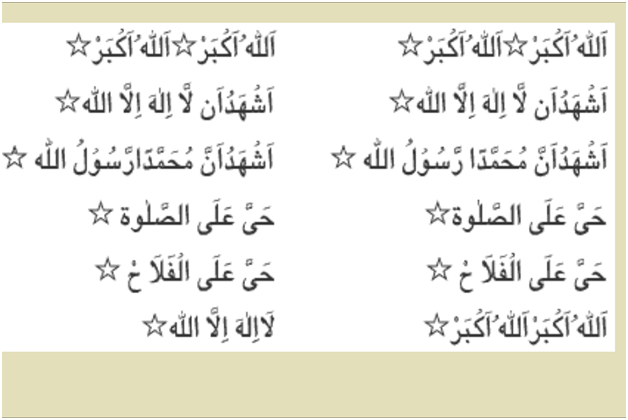
Following are the words of Azan
Allahu Akbar
God is Great
(said four times)
Ashhadu an la ilaha illa Allah
I bear witness that there is no god except the One God.
(said two times)
Ashadu anna Muhammadan Rasool Allah
I bear witness that Muhammad is the messenger of God.
(said two times)
Hayya 'ala-s-Salah
Hurry to the prayer (Rise up for prayer)
(said two times)
Hayya 'ala-l-Falah
Hurry to success (Rise up for Salvation)
(said two times)
Allahu Akbar
God is Great
(said two times)]
La ilaha illa Allah
There is no god except the One God
For the pre-dawn (fajr)
prayer,
the following phrase is inserted after the fifth part above,
towards the end:
As-salatu Khayrun Minan-nawm
Prayer is better than sleep
(said two times)
Azans on Youtubes
Makkah Azan
https://archive.org/details/MakkahAzan
Azaan in Makkah Beautiful Voice SUBSCRIBE please
https://www.youtube.com/watch?v=EqgU3pX9vUA
Madina Azan
https://www.youtube.com/watch?v=DCd0oxTM02M
Sheikh Abdul majeed Most beautiful Azan
https://www.youtube.com/watch?v=5glgAGGRApY
Most beautiful azan ever heard which will make you cry - Sheikh
Zayed Grand Mosque
https://www.youtube.com/watch?v=otdgbR3yso0
Most Beautiful Azan ever heard.
https://www.youtube.com/watch?v=mUHDYlJHaOQ
Azan by Sh. Ali Ahmed Mualla
https://www.youtube.com/watch?v=DCd0oxTM02M
TOP
37.
Videos
Salat method demo
https://www.youtube.com/watch?v=kScrL8m1qMs
AZAN main " Assalato Khairum Minan Naom "
(Engr. Muhammad Ali
Mirza)
https://www.youtube.com/watch?v=8JNaKKghXn4
How to Perform Salah (Same Way to Pray for Men and Women)
https://www.youtube.com/watch?v=w9ktd7q1zje
How to Pray like the Prophet Muhammad Salat's
https://www.youtube.com/watch?v=wu5ukz4r5gk
How To Pray - (Description of Prayer) - Shaikh Jibrail Muhsin
https://www.youtube.com/watch?v=zqjk-gltjeq
Understanding The Salah ᴴᴰ | Mufti Ismail Menk
https://www.youtube.com/watch?v=ogpcmjz7zto
Most common mistakes in the Prayer
https://www.youtube.com/watch?v=dClt_aGyajA
5 Times When Allah Accepts Your Dua
https://www.youtube.com/watch?v=jI9dt_6VjOk
The Best Time To Make Dua
https://www.youtube.com/watch?v=md-eYP2p5pQ
3 Things Happen When You Make Dua | *Must Watch*
https://www.youtube.com/watch?v=EQdWRVqRRbU
Hundreds of thousands of pilgrims attend prayers in Mecca
https://www.youtube.com/watch?v=EP-UY5PJs94
Moving the index finger during tashud in prayer
https://www.youtube.com/watch?v=izsvrhpsw-w
Debate about Finger & Hand |Powerful Reminder| By Mufti Menk
https://www.youtube.com/watch?v=gvfd6bbkmxa
Walking or Passing in front of a person who is praying - Sheikh
Assim Al Hakeem
https://www.youtube.com/watch?v=jtt4b2xpgyo
What's the procedure if one forgets to make Sujood as Sahu
Prostration of forgetfulness?
https://www.youtube.com/watch?v=cbdub0s416y
Making up for years of missed prayers
https://www.youtube.com/watch?v=ayxqzdhglsg
What is the ruling on folding the lower garment in the salah #HUDATV
https://www.youtube.com/watch?v=vdmoh-p6nju
Can Dua Change Qadr (Destiny)? - Dr Muhammad Salah
https://www.youtube.com/watch?v=vtm_mzr5bmw
Making dua after prayer
https://www.youtube.com/watch?v=9f-r9iohif8
Closing the eyes while praying!
https://www.youtube.com/watch?v=qrc7hyjmewa
How many times do we have to raise hands in Salah
https://www.youtube.com/watch?v=lg0htbtce7o
What is the ruling on folding the lower garment in the salah #HUDATV
https://www.youtube.com/watch?v=vdmoH-p6njU
Folding / Rolling up pants above ankle for salah | Sheikh Assim
Al Hakeem
https://www.youtube.com/watch?v=cRs0cguPw0E
The whispering of shaytân when praying and doing ablution? - Dr.
Haitham Al-Haddad
https://www.youtube.com/watch?v=wqeedux7qda
What's the distance and how many days are considered as
'Traveling'?
https://www.youtube.com/watch?v=aogotjb1xdi
Congregational dua, after every fard salah is bidah
https://www.youtube.com/watch?v=tzfxicj-7ds
Dhikr in Congregation
https://www.youtube.com/watch?v=4njnwednuvu
Prohibited times of prayer - Jibrail Muhsen
https://www.youtube.com/watch?v=MU3hJBsMNv0
Changing positions after praying a Fardh prayer in order to pray
a Sunnah prayer
How to Send our Salam (salutation )to beloved Prophet
Muhammed(SAW)
https://www.youtube.com/watch?v=BqrNu5boxQM
TOP
|
|