
|
ISLAMIC -
ISLAMIC |
|
|
|
|
PILGRIMAGE AND UMRA.
2) Pilgrimage: On behalf of others 3) HAJJ FOR DECEASED NOT FOLLOWING ISLAM 4) HAJJ FOR DECEASED PARENTS BY SOMEONE ELSE 6) WEARING UNSTITCHED SLIPPERS 8) Pilgrimage: With company loan outstanding 10) TOUCHING OF BLACK STONE IN HAJJ 11) PERFORMING UMRA IN HAJJ MONTHS 13) Umrah: Entering the state of Ihram 14) Shortening the hair after UmraH OR HAJJ 15) SACRIFICING ANIMAL ON EID AL ADHA BY ALL MUSLIMS 16) WOMEN HAJJ WITHOUT MAHRAM WHEN SAFETY AVAILABLE 17) WOMEN, IF SHE GETS PERIOD WHILE PERFORMING HAJJ? 18) WIFE HAJJ 19) STONING SHAITAN 21) CROSSING MEEQAT WITHOUT IHRAAM 22) HAJJ & UMRAH 23) VIDEOS
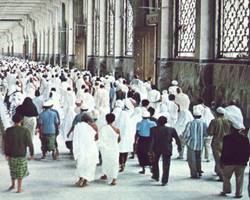
Question : Describe Hajj is obligatory on Muslims. Whhat are lessons that Muslims can learn from Hajj. Would you please shed some light on this point? Answer : Hajj is one of the important pillars of Islam. Every Muslims who has capability to do it, then it is mandatory on him. Allah says: “The first House (of worship) appointed for men was that at Bakka: Full of blessing and of guidance for all kinds of beings” (96) “.... And Hajj (pilgrimage to Makkah) to the House (Ka‘bah) is a duty that mankind owes to Allah, those who can afford the expenses (for one’s conveyance, provision and residence); and whoever disbelieves (i.e. denies Hajj (pilgrimage to Makkah), then he is a disbeliever of Allah), then Allah stands not in need of any of the ‘Aalameen (mankind, jinn and all that exists)” (Aale Imraan 3:96 - 97) And proclaim among men the Pilgrimage: they will come to you on foot and on every lean camel, coming from every remote path (27) That they may witness things that are of benefit to them, and mention the name of Allah on appointed days over the beast of cattle that He hath bestowed upon them. Then eat thereof and feed therewith the poor unfortunate (28) Then let them complete the prescribed duties (Manâsik of Hajj) for them, and perform their vows, and circumambulate the Ancient House (the Ka'bah at Makkah)” (Al-Hajj 22:26 - 29) The Prophet (peace and blessings be upon him) said, “Islam is built upon five pillars: testifying that there is no true god except Allah and that Muhammad is the Messenger of Allah, performing Prayer, paying the Zakah, making the pilgrimage to the Sacred House (Hajj), and fasting the month of Ramadan.” (Reported by Al-Bukhari) Hajj contains many lessons that Muslims should learn. It assures the fact that all Muslims are one Ummah and inculcates in the pilgrims the unique values of Islam.
The first ten days of Dhul Hijjah are the most sacred days of the year. They are mentioned as special days in Surat Al-Fajr. These are the days of special blessings. Muslims are urged to do more dhikr (remembering Allah), charity and good deeds during this time. Fasting in these days is prescribed as nafl (supererogatory act of worship) from first to the ninth day of Dhul Hijjah. The Prophet (peace and blessings be upon him) said: "There are no days in which righteous deeds are more beloved to Allah than these ten days." The people asked, "Not even jihad for the sake of Allah?" He said, "Not even jihad for the sake of Allah, except in the case of a man who went out to fight, giving himself and his wealth up for the cause, and came back with nothing." (At-Tirmidhi)
At this
time millions of Muslims are gathering in and around the sacred city of
Makkah. They are coming from every corner of the globe to perform the
sacred rites of Hajj. We pray to Allah to bless all Muslims and accept
their Hajj and devotions.
2. Hajj
gives the universal spirit of Islam. People of all races, colors and
nationalities go there. They become one people without any class or
distinction. They look alike and do the same things. The spirit of Hajj
is to foster unity and universal brotherhood and sisterhood among the
believers.
4. Hajj
is the ceremony of peace and harmony. The pilgrims come in peace and
spend their time together in the most peaceful and respectful manner.
They respect every person and every thing. They do not harm anyone or
anything. This is also the spirit of Islam. Islam is a total commitment
to care, compassion and kindness. Hajj is the symbol of this commitment
and it must be manifest in our daily life.
2. Pilgrimage: On behalf of others Question : My father-in-law is very old and physically too weak to undertake the pilgrimage himself from India. He has requested me to perform the pilgrimage on his behalf and he will meet the expenses. Is this permissible? May I add that I lost both my parents many years ago. Neither of them offered the pilgrimage during their lifetimes. Can I offer the pilgrimage on their behalf now? If so, to whom should I give priority? Is it permissible to offer the pilgrimage or the Umrah on behalf of a person who is not alive? Answer : Of course it is permissible to offer the pilgrimage or the Umrah on behalf of a deceased person, particularly a parent or a close relative. You have only to make your intention clear before you embark on your pilgrimage journey that you are offering the pilgrimage on behalf of the person concerned. If you do it on behalf of a deceased parent, it is a mark of dutifulness for which Allah will undoubtedly reward you and He will, if He so wishes, credit its reward to your parents. A living person who is too ill or too old to undertake the journey may ask someone else to do the pilgrimage on his behalf. When you do so, you have to cover his expenses. Indeed, the case of your father-in-law is a classic one for a person who may appoint someone else to do the pilgrimage on his behalf. Since he is too old and too weak to undertake the journey, he is unlikely to acquire enough strength to do the pilgrimage later. Therefore, he should appoint someone else to do it. That person need not be a relative. A person in this situation should cover all the expenses of the person offering the pilgrimage on his behalf. The latter should be careful what he spends. He should always be reasonable. He may not invite others to anything at the expense of the person who appointed him. However, if the first person tells him: Do the pilgrimage on my behalf and I will give you, say, ten thousand riyals, he is free to spend it as he wishes, provided that he makes sure to fulfill the duties of pilgrimage in the right manner. Scholars are of different views on whether such a person may receive wages for undertaking the pilgrimage on behalf of someone else. Imam Abu Hanifah says that this is not permissible, while Al-Shafie and Malik say that he may have some wages. [In either case, it is better that a mutually agreed sum is handed out for expending to the person appointed for performing the pilgrimage on your behalf; as thus providing him with a free hand to spend as he wishes without worry about accountability. [His only concern shall be the fulfillment of all the duties of pilgrimage.] With regard to my first reader's question about the priority, I would say that his deceased parents have a stronger claim on him. He should begin by offering the pilgrimage on behalf of his mother. He then tries to offer another pilgrimage on behalf of his father. Subsequently, he may offer the pilgrimage on behalf of his father-in-law, if he so wishes. The reason for this ruling is that his father-in-law may appoint someone else to do the pilgrimage on his behalf. My reader may wish to write to his father-in-law and explain this to him. He may suggest to him to appoint a friend whom my reader trusts as a man of integrity, honor and piety. If the deceased parents made a will before their death, left the necessary money for Hajj and asked their children to make Hajj on their behalf, then the children must make Hajj, either themselves or should send someone to make Hajj, on behalf of their dead parents. Our Dialogue ( Source : Arab News - Jeddah )
3. HAJJ FOR DECEASED NOT FOLLOWING ISLAMQuestion: Can one perform Hajj on behalf of the deceased relatives (for example parents) who did not follow the commands of Allah such as Prayer and Fasting during their life? But they were kind parents and gave much charity but neglected their religion and did not pay proper Zakah. At the time of death, they had not mended their ways even though they had examples all around them of good Islamic practices and behavior. What does one do in that case? Answer : In his response to the question in point, Dr. Muzammil Siddiqi, former president of the Islamic Society of North America, states the following: If the deceased parents made a will before their death, left the necessary money for Hajj and asked their children to make Hajj on their behalf, then the children must make Hajj, either themselves or should send someone to make Hajj, on behalf of their dead parents. However, if the parents did not make a will, but children wish to make Hajj on behalf of their parents they are permitted to do so. Those children will receive the reward and also the reward will be for their parents. There is nothing wrong, as far as Islam is concerned, in making du`aa' or performing Hajj on behalf of the parents who were neglectful in their religious duties, as long as they died Muslims. The children should pray for their parents and should ask Allah to forgive them. It stands to reason that all Muslims should try their best to live by Allah's rules, but we are all neglectful, some more and some less. We should pray for those who passed away as Muslims, and we should urge our children and others to do that for us when we leave this world. Excerpted, with slight modifications, from: www.islamonline.net 4. HAJJ FOR DECEASED PARENTS BY SOMEONE ELSEQuestion: My mother and father have passed away without performing the obligatory Hajj. Is it permissible for me to authorize someone who can perform this obligation on their part, or is this not permissible? According to the case raised in the question, it is permissible for the son to perform Hajj or to get someone to perform Hajj on behalf of his dead father. There are many evidences which support this in the Prophetic Sunnah. In his response to your question, Sheikh Yusuf Al-Qaradawi, the well-known prominent Muslim scholar, states the following: The basis of acts of worship, specifically the physical acts of worship, is that a person performs them himself. If one has not performed them himself, then it is allowable for his children to perform them for him. The Prophet (peace and blessing be upon him) said: “Your children are part of your earnings.” The child of a person is part of him, and he is a part of the child’s actions. He is considered as an extension for him after he dies, just as it has come in the Hadith: “If the son of Adam dies, his actions are ceased except three: A continuous charity, knowledge which benefits others, or a righteous son supplicating for him.” So the righteous son is an extension of the life of his father and an extension of his existence. Understanding this it is then permissible for the children to perform Hajj in lieu of their father. If they do not perform it, then it is then allowable for them to send someone else to perform it for them. There was a woman who came to the Prophet (peace and blessing be upon him) and she said that her father was an old man and was not able to handle the journey and so the obligation from Allah concerning the Hajj was not performed by him and he later died. Should she perform Hajj for him? He said: “Yes. Perform Hajj for him.” Another woman - as was reported in the Hadith of Ibn `Abbas - asked the Prophet (peace and blessing be upon him), if she should perform Hajj for her mother who vowed to perform Hajj for the sake of Allah but had died. He said: "Perform Hajj for her. Have you seen that if she had a debt, you would have paid for her?" She said: "Yes." He (peace and blessings be upon him) said: "So pay it. For Allah has more right to be paid." In another narration we read:“For the debt to Allah has more right to be paid.” So, just as the son is to pay the debts of his father in the matter concerning wealth, the same is to be done for spiritual matters and matters of worship. Therefore either the daughter or the son can perform Hajj for their father or at the least they can entrust somebody to perform Hajj for him. But the one that will do this must depart for Hajj from the deceased’s country (i.e. the country that the deceased would have departed from). If he was from Qatar, for example, then the person must depart from Qatar and nowhere else. If he was from Syria, then the person departs from Syria, and so on. And this should be done unless the financial situation of the deceased is incapable of supporting this - that is if the Hajj expenses will be paid by that source. Whatever is possible should be done. And if the son will authorize somebody, using his own money, to perform Hajj on behalf of his father, then this should also be in accordance to whatever his financial situation will allow. Finally, whoever would perform Hajj on behalf of someone else is required to have first performed Hajj for himself. Excerpted, with slight modifications, from: www.islamonline.net Question : I know that Hajj is not obligatory for one who owes a debt. Does this apply to one who has long-term debts? Some people may have mortgages which will take a lifetime to pay off. Do they have to perform Hajj? Answer : Praise be to Allah. A debt which is due, takes precedence over Hajj, because this obligation comes before Hajj. So you should pay off the debt and do Hajj. If you have nothing left after paying off the debt, then you should wait until Allah ables you with means. If it is a long-term debt to be paid off at a future date, and if you are able to afford it and to pay the installment that is due at the time of Hajj, then you have to go for Hajj. If you cannot to pay the installment and go for Hajj at the same time, then you must give precedence to paying off the installment that is due, and delay Hajj until you can afford it, because Allah says (interpretation of the meaning): “.... And Hajj (pilgrimage to Makkah) to the House (Ka‘bah) is a duty that mankind owes to Allah, those who can afford the expenses (for one’s conveyance, provision and residence); and whoever disbelieves [i.e. denies Hajj (pilgrimage to Makkah), then he is a disbeliever of Allah], then Allah stands not in need of any of the ‘Aalameen (mankind, jinn and all that exists)” (Aale Imraan 3:97) So if there is no guarantee that you will be able to pay it off as agreed, then you should wait until the date for the payment comes. And Allah knows best. Excerpted, with some modifications, from: http://islamqa.com/en/ 6. WEARING UNSTITCHED SLIPPERSQuestion: Ihram for men- is it necessary to wear to unstitched slippers? Can sandals be worn? What about women, can she cover her entire feet while in state of Ihram?
Answer :
Excerpted from: www.islamonline.net 7. DHUL-HAJJA 10 DAYSQuestion: As the ten blessed days of Dhul-Hijjah are approaching, I know that these are virtuous days, in which good deeds are highly recommended by the Prophet (peace and blessing be upon him). But my question is: could you please shed light on the virtue and merits of these blessed days? Answer: Shedding more light on this issue, we'd like to cite the following Fatwa issued by Sheikh M. S. Al-Munajjid, a prominent Saudi Islamic lecturer and author: Praise be to Allah Who has created Time and has made some times better than others, some months and days and nights better than others, in a sense that rewards are multiplied many times than the case in other periods of time. This reflects Allah’s overflowing mercy towards His servants, and it encourages them to do more righteous deeds and makes them more eager to worship Him, so that the Muslim renews his efforts to gain a greater share of reward, prepare himself for death and supply himself in readiness for the Day of Judgment. This season of worship brings many benefits, such as the opportunity to correct one’s faults and make up for any shortcomings or anything that one might have missed. Everyone of these special occasions involves some kind of worship through which the servants may draw closer to Allah, and some kind of blessing through which Allah bestows His favor and mercy upon whomsoever He wills. Happiness and success are for the one who makes the most of these special months, days and hours and draws nearer to his Lord during these times through acts of worship and righteousness. The Muslim must understand the value of his life, increase his worship of Allah and persist in doing good deeds until the moment of death. Almighty Allah says, “And worship your Lord until there comes unto you the certainty” (Al-Hijr 15:99) The scholars say: ‘The certainty’ means death. Among the special seasons of worship are the first ten days of Dhul-Hijjah, which Allah has preferred over all the other days of the year. Ibn `Abbas (may Allah be pleased with him and his father) reported that the Prophet (peace and blessings be upon him) said: "There are no days in which righteous deeds are more beloved to Allah than these ten days." The people asked, "Not even Jihad for the sake of Allah?" He said, "Not even Jihad for the sake of Allah, except in the case of a man who went out to fight, giving himself and his wealth up for the cause, and came back with nothing." (Reported by Al-Bukhari) Ibn `Abbas (may Allah be pleased with him and his father) also reported that the Prophet (peace and blessings be upon him) said: "There is no deed more precious in the sight of Allah, nor greater in reward, than a good deed done during the ten days of Sacrifice." He was asked, "Not even Jihad for the sake of Allah?" He said, "Not even Jihad for the sake of Allah, except in the case of a man who went out to fight giving himself and his wealth up for the cause, and came back with nothing." (Reported by Ad-Darimi) These texts and others indicate that these ten days are better than all the other days of the year, with no exceptions, not even the last ten days of Ramadan. But the last ten nights of Ramadan are better, because they include Laylat al-Qadr, which is better than a thousand months. Thus the various reports may be reconciled. (See TafsirIbn Kathir, 5/412) You should know, dear questioner, that the virtue of these ten days is based on many things: 1- Allah swears an oath by them, and swearing an oath by something is indicative of its importance and great benefit. Almighty Allah says: “By the dawn; by the ten nights” (Al-Fajr 89: 1-2) Ibn `Abbas, Ibn Az-Zubayr, Mujahid and others of the earlier and later generations are of the opinion that this refers to the first ten days of Dhul-Hijjah. Ibn Kathir said: "This is the correct opinion." (TafsirIbn Kathir, 8/413) 2- The Prophet (peace and blessings be upon him) testified that these are the best days of this world, as we have already quoted above from authentic hadiths. 3- The Prophet (peace and blessings be upon him) encouraged people to do righteous deeds because of the virtue of this season for people throughout the world, and also because of the virtue of the place - for the pilgrims to the Sacred House of Allah.
4- The
Prophet (peace and blessings be upon him) commanded us to recite during
this time a lot of tasbih
(glorification of Allah), as well as tahmid
(praising Allah) and takbir (saying
'Allah is Greatest'). 5- These ten days include the Day of `Arafah, on which Allah perfected His religion. Fasting on this day will expiate for the sins of two years. These days also include the Day of Sacrifice, the greatest day of the entire year and the greatest day of Hajj, which combines acts of worship in a way unlike any other day. 6- These ten days include the days of Hajj. Excerpted, with slight modifications, from: www.islamonline.net 8. Pilgrimage: With company loan outstanding Question : Is Pilgrimage with company loan outstanding allowed? Answer : If the Company gives loans for buying a car, it suggests that they are pleased with your work and intend to retain you for a long time to come. That will make it easy for you to settle the loan by monthly installments. Moreover, if something should happen to you, the company may take the car and sell it in order to get back the amount it had loaned. The company must consider that the car represents more than sufficient collateral to ensure the payment of their loan. It is perhaps worthwhile to explain an important point about pilgrimage and debt. When a person has incurred a debt, and he needs some time before being able to settle it, he does not fulfil the conditions which make him "able" to do the pilgrimage. In other words, he is not required to do it, since pilgrimage is a duty incumbent on those who are able to undertake the journey. I have already explained that by ability, most scholars mean health and financial ability, as well as the absence of any physical hindrance to prevent from taking the journey. The condition of financial ability is not met by anyone who has a loan to pay. Therefore, he is not required to fulfil the duty of pilgrimage until he has repaid the loan. Our Dialogue ( Source : Arab News - Jeddah ) 9. FASTING ON ARAFAH DAYQuestion : Is it Sunnah for pilgrims to fast on the day of `Arafah? Answer : In this regard, we will cite what Sheikh Sayyed Sabiq, states in his well-known book, Fiqh As-Sunnah: It is confirmed that the Prophet (peace and blessings be upon him) did not fast on the Day of `Arafah. The Prophet (peace and blessings be upon him) said: "Verily the Day of `Arafah, the Day of Sacrifice (Yawm An-Nahr), and the days of Tashriq (the 10th, 11th and 12th of Dhul Hijjah) are our days of festivities. These are the days of eating and drinking." It is also established that the Prophet (peace and blessings be upon him) forbade fasting on the Day of `Arafah for those who are at `Arafah (for pilgrimage). Abu Hurayrah, (may Allah be pleased with him), narrates that the Prophet, (peace and blessings be upon him), “Forbade fasting on the day of `Arafah for one who is actually at `Arafah." (Reported by Ahmad, Abu Dawud, An-Nasa'i, and Ibn Majah.) This has led most scholars to conclude that it is desirable not to fast on the Day of `Arafah, so that the pilgrim will be strong enough to devote himself wholeheartedly to worship and supplicating. Some of the hadiths that encourage fasting on the Day of `Arafah are concerned with the people who are not staying at `Arafah as pilgrims performing Hajj. Excerpted, with slight modifications, from: www.islamonline.net 10. TOUCHING OF BLACK STONE IN HAJJQuestion : What is the significance of the Ka`bah? I converted to Islam last year by marriage, and a non-believer told me that Muslims go to Hajj just to touch the stone. Is this true? If not, why is it that all Muslims pray toward the Ka`bah and toward the East? I would like to learn more about my religion so when someone tells me something like this, I can tell them the truth about Islam. Answer : Responding to the question in point, Sheikh Ahmad Kutty, a senior lecturer and an Islamic scholar at the Islamic Institute of Toronto, Ontario, Canada, states: Allah says in the Qur’an, “The first sanctuary ever built for mankind was that at Bakkah (Makkah), a blessed place, a guidance to the peoples” (Aale `Imran 3: 96). Thus, by ordering us to face towards the Ka`bah, we are taken back to our Adamic roots. One of the most essential messages of Islam is to break the barriers such as race, language and ethnicity, etc. that separate human beings from one another by stressing their common origin in Adam and Eve. We need not emphasize the fact that racism is the scourge of humanity in all times. Thus, through its entire teachings, Islam cuts at the root of this menace. It is no wonder then that all of the Islamic rituals of worship stress equality and egalitarianism rather than division and distinction based on caste, clan or status. One of the last messages delivered by the Prophet during his farewell pilgrimage was, “O people, (through Islam) Allah has abolished from your hearts your boasting on your ancestors… All of you are descended from Adam and Adam is created from the dust (of the ground.)”
Islam
teaches us to worship one and only God. Unlike all other religions,
which tend to revere their founders excessively often to the point of
worshiping them, Allah makes the Prophet Muhammad to declare:
“I am only a human being like you .…”
(Al-Kahf
18: 110) While it is true that while going around the Ka`bah, some pilgrims may touch the black stone, doing so is not an integral rite of Hajj. It is therefore totally absurd and incorrect to say that Muslims go to Makkah to touch the stone. Touching the stone is a mere symbolic act; it is merely intended to symbolize the beginning of the ritual of circumambulation around the Sacred House. In this context, it is worth remembering what the Caliph `Umar said while touching the black stone: “I know for a certain fact that you are simply a stone; you have no power to benefit or harm anyone; if I hadn’t seen the Prophet touching you I wouldn’t have even bothered to touch you.” We do not attach any importance to this stone other than the fact that it was placed there by Prophet Ibrahim by the order of Allah. So we are merely renewing our memory of the great Prophet, whose faith and sacrifice is celebrated in the rituals of Hajj. If anyone is telling you otherwise, he is distorting Islam. Anyway, a non-Muslim is not the source to learn about Islam. The source for Islam is the Qur’an and the Sunnah and those who are well versed in these sources. Finally, it is not true to say that Muslims always turn to the East; rather they always turn towards the Ka`bah while performing their prayers, and its precise direction may be different, depending on where we are located in the world. The Ka`bah is the first and the most ancient house of worship ever built for all of humankind and dedicated to the worship of one God. So by facing toward the Ka`bah in our prayers, we are stressing the unity of humankind under the Lordship of the One and only God. Moreover, by facing toward the Ka`bah, we are stressing the idea of centrality of God in our life. Excerpted, with slight modifications, from: www.islamonline.net TOP11. PERFORMING UMRA IN HAJJ MONTHS Question : Pls. guide me that can I perform umrah in Shawwal, Dhul Qi`da or in Dhul HIjjah. I have heard that if one performs umrah in these 3 months it will be obligatory to perform Hajj also. As I am residing in Saudi Arabia does this restriction also implies on me. Answer : Certainly, one is allowed to perform `Umrah without Hajj during the months of Hajj, and there is nothing wrong with that at all. The Prophet (peace and blessings be upon him) performed `Umrah four times, all of which were in the month of Dhul-Qi`dah, which is one of the months of Hajj, which are Shawwal, Dhul-Qi`dah and Dhul-Hijjah. And he did not perform Hajj except along with his last `Umrah, in the Farewell Pilgrimage. Also, there is nothing in the sources to the effect that one must perform Hajj with `Umrah if he is going to perform `Umrah during the months of Hajj. Excerpted, with slight modifications, from: www.islamonline.net Question : Can one person perform a second Umrah immediately after he has finished the first one? Answer : There is nothing to stop a person from offering another Umrah after he has finished one. However, when he finishes the Umrah, he has to release himself from ihraam. For second one, he has to go to the nearest point of the "hill" area, i.e. outside the Haram area, to put on his ihram, and declare his intent there. He cannot do that in Makkah itself. Maybe it is convenient for him to put on his ihram, garments in Makkah, but he does not make the declaration of intent until he has gone out, at least to the nearest place outside the Haram area. The place most people prefer, is called Al-Taniem. I think I have to explain that in normal cases, one Umrah a year is sufficient for any person. If one is visiting Makkah, whether he is coming from a far away place or from Jeddah, or Dhahran or even nearer, he needs to do only one Umrah. If he is staying in Makkah for several days, he can do the tawaf as frequently as he can. But you realize, that tawaf is considered in the same light as prayer. The only different is that it is permissible to talk during tawaf while ordinary talk in prayer invalidates it. You can do one tawaf after another, without any restrictions. Sa'ie , the other main feature of Umrah, is not something we are encouraged to do voluntarily. We do only one sa'ie for Umrah and one for pilgrimage and we are not encouraged to repeat that sa'ie. Therefore, when we do the tawaf voluntarily, we are doing the part of Umrah which can be offered in voluntary worship. Our Dialogue ( Source : Arab News - Jeddah ) 13. Umrah: Entering the state of Ihram Question : If I travel in Jeddah for some personal business and then perform Umrah after its completion, where do I enter into the state of consecration? Answer : If your journey is for some business which may take you a day or two, and then you want to do the Umrah after you have finished, you do not have to enter into the state of consecration, i.e. Ihram, at the point of Meeqat. Indeed, your point of Meeqat is Jeddah, because that is the place where you are at the end of your business. I should point out that much of this question depends on intention. Let me give you the other possibility. If a person in your home town decides to do the Umrah, and then it occurs to him that he has some business to do in Jeddah, then his case is totally different. Although he wishes to go to Jeddah first in order to complete his business, he should enter into the state of consecration at the point of Meeqat, i.e. Rabigh. The difference between the two situations is the intention. In the first case, the trip to Jeddah is for business. In the second, the whole trip is for Umrah. Therefore, in the second case, every condition of the Umrah should be observed right from the beginning. A pilgrim or a Muslim doing the Umrah must enter into the state of consecration at the point of Meeqat. In the first case, the trip to Jeddah is the original trip, and the intention is to do the business there. The Umrah is incidental to the journey and, therefore, it begins with entering into the state of consecration at the point of Meeqat relevant to him. Since he is in Jeddah, then Jeddah is his Meeqat. Our Dialogue ( Source : Arab News - Jeddah )
14. Shortening the hair after Umrah OR HAJJ Question : Many people do not shave their heads at the conclusion of Umrah. Is this permissible? If one wants to offer more than one Umrah, how could he shave? Answer : It is sufficient to shorten one's hair, or even to shorten a few hairs in order to fulfill the requirement of Umrah or Hajj. It is certainly more preferable to shave one's head, since the Prophet prayed three times for those who shaved before including [a prayer] those who shortened their hair. However, if one prefers to keep his hair for any reason, he violates no rule or regulation of Umrah or Hajj. If you have shaved your hair after completing one Umrah or Hajj, and then you performed another, you can fulfill the requirement of going over your head with a razor. Our Dialogue ( Source : Arab News - Jeddah ) 15. SACRIFICING ANIMAL ON EID AL ADHA BY ALL MUSLIMSQuestion: I want to know whether it is obligatory on all Muslims to sacrifice an animal on `Eid Al-Adha, or is it obligatory only upon the pilgrims and a Sunnah for the rest of the Ummah? Answer:
According
to the vast majority of scholars and imams, offering a sacrificial
animal on `Eid Al-Adha by non-pilgrims is not considered as obligatory
but only sunnah mu’akkadah (highly recommended act). As far as sacrifice of animals on `Eid Al-Adha with respect to non-pilgrims is concerned, according to the vast majority of scholars and imams, it is not considered as obligatory but only sunnah mu’akkadah (highly recommended act). Imam Abu Hanifah, however, adopted the position that sacrifice is obligatory upon those who can afford to do it. All other scholars and jurists, including the Prophet’s Companions, successors and others, do not consider sacrifice as obligatory but as a strongly recommended Sunnah. Ibn Umar said: The Prophet lived in Madeenah for 10 years and every year he slaughtered an animal." (Ahmad-Saheeh by al-Albaani) Imam Muslim reported on the authority of Umm Salamah that the Prophet (peace and blessings be upon him) said, “When the ten days of Dhul-Hijjah enters, if anyone wishes to sacrifice, he must not remove his hair or nails (until the sacrifice is done).” Imam Ash-Shafi`i comments on this saying, “It is clear from the phrase, ‘if anyone wishes to sacrifice’ that sacrifice is only recommended and not obligatory on everyone.”
Imam Ahmad
and Ibn Majah reported that the Prophet (peace and blessings be upon
him) said when asked about the significance of sacrifice,
“It is a
sunnah of your ancestor Ibrahim (upon whom be peace).” Excerpted, with slight modifications, from: www.islamonline.net
16. WOMEN HAJJ WITHOUT MAHRAM WHEN SAFETY AVAILABLEQuestion: My question is about a woman who wants to perform Hajj but she does not have a husband or a mahram that can accompany her. Is it permissible for her to perform Hajj along with groups of Muslim males or females, keeping in mind that today the streets are safe and that traveling isn’t such a risk as it were before? Or do you see that it is obligatory upon her to delay Hajj until she gets a mahram? Answer:
As regards
your question, the following is the fatwa issued by the prominent Muslim
scholar, Sheikh Yusuf Al-Qaradawi, in this regard:
And also
on the authority of Abu Hurayrah (may Allah be pleased with him) the
Prophet (peace and blessings be upon him) is quoted to have said:
“It
is not permissible for a woman who believes in Allah and the Last Day to
travel a distance of one day and one night without a mahram with
her.”
Abu Sa`id narrated that the Prophet (peace and blessings be upon him)
said:
“A woman is
not to travel a distance of two days without her husband or mahram
with her.” The basis for this ruling is not an evil assumption about the woman and her manners, as some people unreasonably think, but it is to take care of her reputation and dignity. It is to protect her from the desires of those who have diseased hearts, from the assault of a rapist or a thief. And this is even more so in places that the traveler must pass through, like deadly deserts, in a time when there is no sense of security, and where the places are unpopulated. But what is the ruling on a woman, who does not find a mahram to accompany her in a legitimate travel, whether obligatory, preferred or permitted? And there is within her reach a group of protective men, or trustworthy faithful women, and the roads are safe? The jurists have researched this topic whenever they discussed the obligation of Hajj upon women, and they kept in mind the Prophet’s injunction prohibiting a woman from traveling without a mahram. Their thoughtful opinions include the following: 1) Among them are those who hold on to what is apparent from the mentioned hadiths, they prohibit traveling without a mahram, even for the obligation of Hajj. And there is no exception to this rule. 2) There are those who make an exception for older women who have passed the age of being subject to temptation, as has been transmitted from Al-Qadi ibn Al-Walid Al-Yaji, from the Maliki Juristic school. It is especially for women in general if we look at the meaning as was said by Ibn Daqiq Al-`Eid. 3) Some of them make the exception that as long as the woman is with trustworthy and faithful women, then the travel is permissible. Furthermore, some conclude that it is enough for just one free trustworthy and faithful Muslim woman. 4) And some concluded that the roadway must be safe. This is the opinion that was chosen by Sheikh ul-Islam Ibn Taymiyyah. He mentioned that Ibn Muflih in Al-Faru` said: “Every woman can perform Hajj without a mahram as long as she will be safe.” And he said: “This is directed towards every travel in obedience... Al-Karabisi transmitted this from Ash-Shafi`i pertaining to the supererogatory Hajj. And some of his companions also said this about supererogatory Hajj and about every travel that is not obligatory, like visiting and trading.” Al-Artham transmitted from Imam Ahmad: “A mahram is not a condition in the obligatory Hajj.” His justification for this is his saying: “Because she goes out with women, and with all those whom she is safe with.” Ibn Siyrin even said: “With a Muslim it is okay.” Al-Awzai said: “With a just people.” Malik said: “With a group of women.” Ash-Shafi`i said: “With a trustworthy faithful Muslim woman.” And his companions said: “By herself if there is safety.” Al-Hafidh Ibn Hajar said: “What is well-known with the Shafi`is is that it is conditional that there be a husband, mahram, or trustworthy faithful women.” And in another saying: “It is enough for just one trustworthy faithful woman.” In a saying transmitted by Al-Karabisi, authenticated in Al-Muhadhab, is that she can travel by herself if the roads are safe. If this is what was said about traveling for Hajj and `Umrah, then this ruling should be uniform concerning all types of travel, as some scholars have agreed. The purpose here is to safeguard the woman and protect her, which is fulfilled by knowing that the roadway is safe and that trustworthy faithful men and women are present. The proof of the permissibility of a woman traveling without a mahram is incumbent upon there being security and the presence of trustworthy faithful people. What was reported by Al-Bukhari is that during the final Hajj of `Umar ibn Al-Khattab (may Allah be pleased with him), he gave permission to the wives of the Prophet (peace and blessings be upon him) to perform Hajj. So he sent with them `Uthman ibn `Affan and `Abdur-Rahman. This act is considered to be a consensus, for all of them, `Umar, `Uthman, `Abdur-Rahman Ibn `Awf and the wives of the Prophet (peace and blessings be upon him) agreed to it, without any objection. Second is what was reported by Al-Bukhari and Muslim from the hadith of `Ada Ibn Hatim that the Prophet (peace and blessings be upon him) told him about the future of Islam and how its light will be spread throughout the earth. Among what he mentioned is: “The day is near when a young woman will travel from Al-Hira (a city in Iraq), going to the Sacred House with no husband accompanying her. She will fear none but Allah.” This information does not only prove that this will happen, but proves its permissibility, because it was mentioned in a phrase praising the spread of Islam along with its sense of security. Here I will state two additionally important precepts: The first is that the basis of rulings on acts of dealings is to focus on their meanings and purposes. This is the opposite of rulings on acts of worship, whose main focus is on showing full compliance to Allah’s order, before focusing on their meanings and purposes, as was firmly established by Imam Ash-Shatibi, who clarified this and verified it with proofs. The second is that prohibited things are not permitted except if there is a dire need. And things that are prohibited so that they can be an obstruction to evil are permitted during times of need. And there is no doubt that the prohibition of a woman traveling without a mahram stems on the necessity of blocking channels to evil.
It is
incumbent upon us to look at traveling in our time. It is not like how
traveling was in the past. It is no more filled with the dangers of the
arid deserts, or awe of being encountered with thieves, highway robbers,
etc. Now traveling is by various modern means of transportation that
usually gather large amounts of people at a time, like ships, airplanes,
buses, or cars that travel in caravans. Thus, this provides plenty of
confidence and reliability, removing feelings of fear for the woman,
because she will not be by herself in any place. Excerpted, with slight modifications, from: www.islamonline.net
17. WOMAN, IF SHE GETS PERIOD WHILE PERFORMING HAJJ?
Question:
What should a woman do if she gets her period while performing Hajj?
Answer:
As regards your question, Sheikh `Atiyyah Saqr, former head of Al-Azhar Fatwa Committee, states: "In an authentic Hadith, the Mother of the Believers, `A'ishah (may Allah be pleased with her) narrated that the Prophet (peace and blessings be upon him) came to her and found her crying. He said, "Have you got your period?" She said, "Yes". The Prophet (peace and blessings be upon him) said, "Allah the Almighty has prescribed this for the daughters of Adam, so do what other pilgrims do except tawaf (circumambulation of the Ka`bah) until you take ghusl (purificatory bath)." (Reported by Al-Bukhari and Muslim) Therefore, a menstruating woman is allowed to stand on Mount `Arafah, to run between the two hills of As-Safah and Al-Marwah, and to stone the Jamarat (pillars). Also, she can make takbir and tasbih and dhikr (remembering Allah). However, she is forbidden from the following: - Offering Prayer (Salah) - Tawaf - Staying at the Mosque - Touching or carrying the Qur'an. Jabir (may Allah be pleased with him) reported that `A'ishah's menstruation started while she was performing Hajj, but she performed all the rites of Hajj except tawaf around the Ka`bah. When her period ended and she became clean, she performed the tawaf and said, "O Prophet of Allah! Everyone has performed Hajj and `Umrah together, but I have performed Hajj only." Thereupon, the Prophet (peace and blessings be upon him) commanded her brother `Abdur-Rahman to accompany her to a place called Tan`im (in order to perform `Umrah). So she performed `Umrah right after Hajj in the month of Dhul-Hijjah.”
Moreover, Sheikh Ahmad Kutty, a senior lecturer and an Islamic
scholar at the Islamic Institute of Toronto, Ontario, Canada, adds: As far as performing tawaf is concerned, they should postpone it until such time that they are free of menses and have purified themselves through ghusl (bathing). If, however, because of special circumstances beyond their control, they find themselves unable to stay in Makkah (for instance, they have no choice but to leave with the group because of inability to change or reschedule travel plans), then they are allowed to perform tawaf while still menstruating after cleaning themselves and wearing pads, etc. The above ruling is given by Imam Ibn Taymiyyah. It has been based on a valid principle of Islamic jurisprudence which states that any condition - upon which the validity of a certain `ibadah (act of worship) is dependent - can be waived if a person cannot fulfill the same; and the `ibadah thus performed will be considered as valid without it. An example for this is covering oneself during Prayer. Thus if a person finds himself unable to cover his `awrah (what must be covered) because he could not find anything to wear, then he must still pray without covering himself and his Prayer will still be considered as valid, although in ordinary circumstances such a Prayer will be considered as null and void. The same rule applies to a menstruating woman who must leave Makkah because of special circumstances beyond her control. The normal condition of purification from menses for the validity of tawaf is be waived in her case, and her Hajj will be considered as perfectly valid.” (Source: www.islam.ca)
Question :
Is it 'Fardh' (obligatory)
for a man to send his dependant wife to Hajj if the man is having enough
money for the same?
Answer :
Praise be to Allah.
It is not obligatory for a
husband to bear the costs of his wife’s Hajj, even if he is rich. Rather
it is mustahabb for him to do so and he will be rewarded for that, but
he is not sinning if he does not do that.
That is not enjoined by
either the Quran or the Sunnah. But Islam gives the wife the Mahr which
is her exclusive right, and it permits her to dispose of her own
wealth.
Rather Islam enjoins on
the husband to spend on his wife in a manner that is good and
reasonable, but it does not oblige him to pay off her debts, or to pay
zakaah on her behalf, or to pay the costs of Hajj etc.
Shaykh Ibn ‘Uthaymeen was
asked: will a husband be rewarded if he appoints someone to do Hajj on
his wife’s behalf, if she dies without having done Hajj?
He said: it is better for him to do Hajj on her behalf himself so that
the rituals will be done properly… Then he said: But as for it being
obligatory, that is not obligatory for him.
Al-Liqa’ al-Shahri, 34,
no. 579
Just as it is not
obligatory to make up Hajj on her behalf after she dies, so too it is
not obligatory for him to pay for her Hajj whilst she is still alive.
And Allah knows best.
Excerpted, with some modifications, from:
http://islamqa.com/en/ TOP19. STONING SHAITANQuestion : Dear scholars, as-salamu `alaykum. If a person throws the pebbles on behalf of another person without being appointed to do so, is this act valid? Answer : It is not permissible to throw pebbles on behalf of others without being authorized except in the case when a person, such as a young child or an unconscious person, cannot authorize another person to do so. Responding to your question, Sheikh Faysal Mawlawi, Deputy Chairman of the European Council for Fatwa and Research, states: If a person cannot throw the pebbles himself during Hajj for some legal excuse, such as sickness, pregnancy, old age, or weakness, it is permissible for that person to authorize someone to throw the pebbles on his behalf if he cannot bear the overcrowded conditions of the pilgrims and is at risk of being harmed. The Shafi`i scholars made the condition that the excuse should be one that it is not likely to be removed before the Days of Tashriq. The one who is authorized must throw his pebbles first, after which he can throw the pebbles on behalf of the other person. It is not permissible to throw pebbles on behalf of others without being authorized. The only exception is if the person cannot authorize another person to do the throwing on his behalf. For example, the father or guardian of a young child can throw the pebbles on his behalf without being authorized. According to Hanafi scholars, the associates of the unconscious person are permitted to throw the pebbles on his behalf without being authorized. Excerpted, with slight modifications, from: www.islamonline.net Question : It takes me about 15 minutes to make sure there is no urine coming out after urinating. Doctors do not know my disease. Is it permissible that I wear a piece of cloth during ihram to avoid disturbing people in toilets? Answer : Praise be to Allah. If the urine stops after this time, then you have to wait, and there is no concession for you in prayer when there is najaasah (impurity) present, because you are not regarded as suffering from incontinence. You should choose times when there is less crowding so that you will not disturb people with your being late. As for putting a piece of cloth over your private part, that is not something that is forbidden when in ihraam. We asked Shaykh Ibn ‘Uthaymeen (may Allah have mercy on him): What is the ruling on the muhrim (pilgrim in ihraam) who suffers from incontinence putting something over his private part, such as a bag, so that the najaasah will not spread? Is this one of the things that are forbidden when in ihraam? He (may Allah have mercy on him) replied: That is not one of the things that are forbidden when in ihraam. And Allah knows best. Excerpted, with some modifications, from: http://islamqa.com/en/ 21. CROSSING MEEQAT WITH OUT IHRAAM Question : This year my husband and I went for Hajj. The trip was from Abu Dhabi to Jeddah, and the captain of the airplane was not Muslim. He told us that in 45 minutes we would be in line with the meeqaat, but after that time had passed, he did not tell us that we were in line with the meeqaat, and we heard some other passengers reciting the Talbiyah. Do we have to offer a sacrifice or not? Answer : Praise be to Allah . If you entered ihraam after you passed the meeqaat, then you have to sacrifice one sheep on behalf of yourself and another on behalf of your wife, to be slaughtered in Makkah and the meat distributed to the poor there. It says in al-Mawsoo’ah al-Fiqhiyyah (22/140): If a person passes the meeqaat without entering ihraam, then he must go back to it and enter ihraam from there if he can. If he goes back and enters ihraam from there, then he does not have to offer a sacrifice, according to scholarly consensus, because he entered ihraam from the meeqaat from which he was enjoined to do so. But if he passed the meeqaat and then entered ihraam, he must offer a sacrifice, whether he went back to the meeqaat or not. This is according to the Maalikis and Hanbalis. End quote. Shaykh Ibn Baaz (may Allah have mercy on him) was asked: what is the ruling on passing the meeqaat for Hajj or ‘Umrah? He replied: It is not permissible for the Muslim who wants to do Hajj or ‘Umrah to pass the meeqaat that he passes through without entering ihraam. If he passes it without entering ihraam, then he must go back to it and enter ihraam from there. If he fails to do that and enters ihraam from a place that is within the boundary or closer to Makkah, then he must offer a sacrifice according to many of the scholars, to be slaughtered in Makkah and distributed to the poor, because he failed to do an obligatory action, which is entering ihraam from the proper meeqaat as prescribed in sharee’ah. End quote. Majmoo’ Fataawa Ibn Baaz (17/9). Shaykh Ibn ‘Uthaymeen (may Allah have mercy on him) was asked: I travelled by plane from Riyadh to Jeddah with the intention of doing ‘Umrah, then the pilot announced that after twenty five minutes we would be passing over the meeqaat, but I missed the time of passing over the meeqaat by four or five minutes, and I completed the rituals of ‘Umrah. What is the ruling? He replied: The ruling according to what the scholars have said is that the questioner must sacrifice a sheep in Makkah and distribute the meat to the poor; if he cannot afford that, then Allah does not burden any person beyond his scope. But I advise my brothers: if the pilot announces that there are twenty five minutes or ten minutes, they should enter ihraam, because some people sleep after that announcement and doe not realize it until the plane is approaching Jeddah. If you enter ihraam twenty five or fifteen minutes before reaching the meeqaat, or an hour or two hours beforehand, there is nothing wrong with that, rather what is wrong is delaying entering ihraam until one has passed the meeqaat. Five minutes in a plane covers a long distance. So I say to the brother who asked this question: sacrifice one fidyah in Makkah and distribute it to the poor on behalf of each of you who did not enter ihraam until after the meeqaat, but in the future, pay attention when the pilot makes the announcement. The matter is broad in scope, so enter ihraam, and even if you fall asleep after that it will not matter. End quote. Al-Liqa’ al-Shahri, no. 56, question no. 4 And Allah knows best.
In
this article the procedure to wear Ihram and to perform the rites of
Hajj and Umrah are presented in a simplified way. Also included is the
procedure to visit the Holy Prophet (pbuh)'s Tomb and his Mosque. 22. HAJJ & UMRAH (STEP BY STEP)
1. IHRAM
The literal meaning of Ihram is to make haraam (forbidden). When
a haji pronounces the Niyyah (intention) of Hajj and Umrah and
utters Talbiyah, ertain halaal (permissible) things become haraam
for him. This combined action (Niyyah and Talbiyah) is called Ihram. The
two sheets that a haji wears are figuratively known as Ihram but the
real Ihram is Niyyah & Talbiyah. If someone wears these two sheets and
does not declare his intention and utter Talbiyah, he does not become a Muhrim.
That is why, before Niyyah and Talbiyah, he can cover his head during
two rakahsof Nafl, an act which is not allowed in the real
state of Ihram.
PROCEDURE
1.
Preparations for Ihram. Comb
your hair, shape the beard, trim your mustache, cut your nails, and
remove unwanted body hair.
2.
Purification. Take
a bath with the intention of Ihram otherwise do wudu. Here it is
noted that there are two ways of purification:
o
Purification of the body, shower or wudu.
o
Internal purification, sincere repentance on your sins. Say something
like this: "O Allah, I sincerely repent on my sins and seek your
forgiveness."
3.
Ihram Sheets. Men
should wear a sheet of white cloth around the waist and cover the upper
body with the other sheet. Women's ordinary clothes are their Ihram.
Both should wear the flip-flops (hawai chappal) so that the
middle bones of the upper part of the feet are not covered.
4.
Nafl Salah. If
it is not makruh (undesirable) time, offer two rakahs of nafl for
Ihram by covering your heads.
5.
Advice. If
going to Jeddah by an airplane, it is convenient to get into the status
of Ihram inside the plane. Here is what you do. Do everything at home or
at the airport except Niyyah (intention) and Talbiyah. Have your shower,
pray two rakahs of nafl but you are still not in the
status of ihram because you haven't done the main thing yet,
i.e., intention and Talbiyah which is done at or before the boundary
line called Miqat.
Go to the airplane and sit down with the white sheets on. In a Hajj
flight when you are close to Miqat, the pilot will announce that
this is the border line to make your intention and to say Talbiyah.
Those who did not change their clothes before should do so now although
it is not convenient inside the plane. Please note that:
o
It is a good idea to ask at the time of boarding if the arrival of Miqat will
be announced by the pilot. If not, make your intention and say Talbiyah
on your own approximately one hour before you reach Jeddah.
o
If you are flying with a group, follow the instructions of the group
leader.
6.
Intention and Talbiyah. Now
uncover your head and declare your intention. It is assumed that you are
performing Hajj al-Tammat'u in which Umrah is performed first as
described later in the "Kinds of Hajj".
"O Allah! I intend to perform Umrah. Please make it easy for me and
accept it from me. Amen."
Immediately after that utter the words of Talbiyah three times and as
often afterwards as possible. If you don't remember it, you can say its
translation in English or in any other language but Talbiah or its
translation is pronounced in a loud voice by men and in a subdued voice
by women.
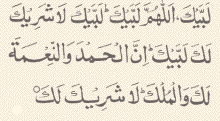
TALBIYAH
7.
8.
Prohibitions of Ihram. After
intention and Talbiyah, you are in the status of Ihram and from this
time on you should not do acts that are forbidden in Ihram , for
example, here are some of the things a muhrim must not do:
o
Cover head (men), cover face (women)
o
Cover the middle bone of the upper part of the feet (Both men and
women))
o
Shave / cut hair
o
Cut nails
o
Wear perfume
o
Wear stitched clothing (men) / (Women can wear their ordinay clothes)
o
Hunting / killing
o
Sex
9.
Journey towards Makkah. When
this sacred journey towards Makkah al-Mukarrama starts, recite Talbiyah
frequently on the way. Then enter the city very humbly and with great
fondness still reciting Talbiyah.
After arranging for your residence, proceed to the Haram Sharif to
perform Umrah.
2. HAJJ
KINDS OF HAJJ
There are three ways of performing the Hajj:
§
Hajj al-Tamatt'u (Interrupted)
§
This is the easiest way of performing Hajj as described below.
§
Hajj al-Qiran (Combined)
§
This denotes entering into ihram for both Umrah and Hajj at the same
time, not taking it off until the day of sacrifice at Mina.
§
Hajj al-Ifrad (Single)
§
This means entering into ihram only for the Hajj and taking it off only
on the day of sacrifice.
HOW TO PERFORM UMRAH
THE RITES OF UMRAH: The
only rites of Umrah are:
·
Entering the state of Ihram
·
Tawaf of Ka’bah
·
Sa’yee between the hills of Safa and Marwah
·
Shaving or clipping of the hair
IHRAM FOR UMRAH AND ENTERING MASJID AL-HARAM
1.
Ihram: You
should be already in Ihram for Umrah before entering Mecca as mentioned
above.
2.
Entering Masjid al-Haram: While
reciting Talbiyah, enter Masjid al-Haram preferably through Bab
3.
First Sight: At
the first sight of Ka’bah, keep your eyes fixed at Baitullah and
standing at one side, it is suggested that you do the following:
§
Say Allahu Akbar three times
§
Say La Ilaha Illallah three times
§
Proclaim Darud on our beloved Prophet (peace be upon him) and very
humbly and with tears in your eyes supplicate to Allah for whatever you
wish. This is a special time for the acceptance of prayers.
After this, while uttering Talbiyah, move forward to perform Tawaf of
Ka’bah.
TAWAF OF
UMRAH
Tawaf means circling around something . Here it means moving around
Ka’bah seven times with extreme love and devotion.
1.
Preparation: Pass
the upper sheet of Ihram from underneath the right arm and put it on the
left shoulder. This act bares the right shoulder and is known as Iztaba.
Ablutions (vudu) is essential for tawaf. Reciting of Talbiyah is stopped
when you reach Hajar-e- Aswad, the starting point of tawaf.
2.
Niyyah (Intention): Stand
in front of Ka’bah facing Hajar-e-Aswad (the Black Stone) in such a way
that the whole Hajre-e-Aswad is on your right side. To achieve this end,
you may get help from the black stripe on the floor. This stripe should
be on your right side. Then without raising your hands make Niyyah
(intention) for Umrah:
" O Allah, I perform Tawaf of Umrah to please You. Make it easy for me
and accept it from me."
3.
Istilam: Now
moving towards right, come in front of Hajar-e-Aswad and kiss it if
possible, or touch it with a stick and kiss the stick; if that also is
not possible, raise your hands to your ears keeping your open
4.
Tawaf Starts: After
Istilam, turn right and start tawaf counter clockwise.
WARNING
§
The authorities often apply perfume to Hajar-e-Aswad, Rukn Yamani and
Multazam. If so, do not touch them while in the state of Ihram,
otherwise a dum will be required as a penalty.
§
During tawaf, it is not permissible to face or turn your back towards
Ka’bah except when you are kissing or pointing towards Hajar-e-Aswad.
5.
Ramal: For
the first three circuits of Tawaf of Umrah and Tawaf of Arrival, men are
required to move their shoulders and walk with quick short steps. This
act is called Ramal and is Sunnah. They walk normally during the
remaining four circuits.
6.
Supplications of Tawaf: There
are no fixed supplications for tawaf but there are several recommended
supplications listed in the books of Hajj and Umrah out of which the
following supplication is easy to memorize:
"Subhan-Allah wal-hamdu-lillahi wa la ilaha ill-Allah wa-Allahu Akbar wa
la haula wa la quwwata illa-billah."
If you don’t remember these words, you may glorify Allah by repeatedly
uttering:
Subhan Allah, Al-Hamdu lilla,
Allahu Akbar, La Ilaha Illallah, etc.
The Prophet of Islam (peace be upon him) has said that there are two
kalimahs that are light on tongue and (on the day of judgment) they
weigh heavy on the scale (Mizan) and are liked by Allah. These kalimahs
are:
Subhan Allah Wabe Hamde hi Subhan Allah Hil Azeem (Bukhari,
Muslim, Tirmizi)
You may also use supplications used in the daily Salah or you may seek
forgiveness of Allah and ask Him whatever you wish in your own language.
7.
Hatim: Hatim
is a semi-circular half-built portion which was originally a part of the
Ka’bah but which could not be included in the main structure when the
Ka’bah was rebuilt. It is obligatory to go around Hatim also while
performing tawaf.
8.
Rukn Yamani and its Supplications: After
passing the three corners of the Ka’bah you reach the fourth corner
known as Rukn Yamani. Touch it with both hands or with right hand. There
is a beautiful supplication to be used while walking between Rukn Yamani
and Hajar-e-Aswad:
"Rabbana atina fid-dunya hasanatan wa fil-akhirati hasanatan wa qina
azabin-nar."
Our beloved Prophet (peace be upon him) has repeatedly recited this
supplication. The first circuit is complete when you reach
Hajar-e-Aswad.
9.
Seven Circuits: At
Hajar-e-Aswad, start the second circuit by kissing it or pointing
towards it as you started the first circuit, i.e., come in front of
Hajar-e-Aswad, raise both hands to your ears with open palms towards it
and say:
" Bismillahi Allahu Akbar Wa Lillah Hil Hamd
Now kiss both palms and drop your hands. After this go around Ka’bah as
you did before and similarly complete the seven circuits.
10.
The End of Tawaf: At
the end of seven circuits, do Istilam of Hajar-e- Aswad or point towards
it eighth time which is Sunnat Mu’akidah. Also say:
"Bismillahi Allahu Akbar Wa Lillah Hill Hamd"
11.
Iztaba Finished : Now
Iztaba is finished, therefore, you cover your both shoulders with upper
portion of the Ihram sheet. This does not apply to women.
12.
Multazam: Now,
come to Multazam which is a place five or six feet in length between
Hajar-e-Aswad and the door of Ka’bah. This is a highly sacred place
where prayers are accepted. Among a large crowd of people, if it is
possible to reach Multazam, cling to it pressing your chest and cheeks,
and while trembling and crying with devotion and with all humility seek
Allah’s mercy, His blessings and ask Him whatever you wish. If you are
unable to come close to Multazam, just face towards it and supplicate
from a distance.
13.
Maqam Ibrahim: Next
offer two rakahs of nafls behind and close to Maqam Ibrahim without
covering
14.
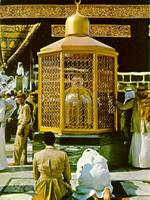
Zamzam: Now
go to Zamzam well situated in the basement of the Haram about 200 feet
from the Ka’bah’s door. There are separate portions for men and women.
Zamzam is the best available water in the world. Drink this water to
fill while in standing position saying Bismillah. Then supplicate to
Allah:
"Allahummah inni as’aluka ilm-an naafi’an wa rizqan waasi’an wa shifa’am
min kulli daa’in."
(O Allah! I implore Thee for beneficial knowledge, for vast provisions,
and for cure from every disease.)
The literal meaning of Sa’ey is to run or to make effort, but as a Hajj
and Umrah term, Sa’ey denotes
search of water for her son. Suddenly the fountain of Zamzam oozed
miraculously near the feet of Hazrat Ismael. Sa’ey is included in the
rites of Hajj and Umrah to commemorate this event of search and
struggle.
1.
Istilam of Hajar-e-Aswad. Before
starting Sa’ey, do Istilam of Hajar-e-Aswad again the ninth time or
point towards it, saying:
"Bismillahi Allahu Akbar Wa Lillah Hil Hamad."
Now Proceed towards Safa. It is a Sunnah to be in the state of ablutions
during Sa’ey.
2.
Start of Sa’ey at Safa. Climb
the hill of Safa and make intention (niyyah) for Sa’ey:
" O Allah! I perform Sa’ey between Safa and Marwah to please You. Make
it easy for me and accept it from me."
Now recite:
"Inn-as-Safa wal-Marwah min Sha’a’irillah."
After this climb Safa to the point from where you can see the Ka’bah,
then facing the Ka’bah raise your hands in supplication, say Allahu
Akbar three times and recite the following supplication or ask Allah
whatever you wish:
"La ilaha ill-Allahu wahdahu la Sharika lahu, lahul-mulku wa lahul-hamdu
wa ‘ala kulli shai’in Qadeer."
If you don’t remember this, you may use the supplication recited earlier
during Tawaf:
"Bismillahi Allahu Akbar Wa Lillah Hill Hamd"
3.
Proceed towards Marwah. Come
down from Safa and move towards Marwah while reciting this supplication:
"Subhan-Allah wal-hamdu-lillahi wa la ilaha ill-Allah wa-Allahu Akbar wa
la haula wa la quwwata illa-billa."
If you don’t remember this supplication also, recite Subhan Allah,
Alhamdu Lillah, Allahu Akbar repeatedly and keep moving. You may
also praise Allah and ask for His mercy in your language or use
supplications taken from the daily Salah. When you reach two green
pillars between which men have to run but the women walk with their
normal pace.
4.
At Marwah. When
on top of marwah, praise Allah facing the Ka’bah and repeat the same
supplications that were recited at Safa. One trip is over, second trip
will be on Safa and third trip will be on Marwah.
5.
End of Sa’ey. In
the same way, the seventh trip will end at Marwah. In all trips the men
will run between the green pillars but the women will walk in a normal
way.
6.
Two raka’at Nafl. If
it is not an undesirable (Makrooh) time, offer two raka’ats of
nafl in the al-Haram.
7.
Shaving or clipping of hair. After
Sa’ey, men should get their heads completely shaved or get their hair
clipped to the length of the upper third of their finger or a little
more. Both shaving and clipping are permissible for men, though shaving
is preferable. Women are, however, allowed to have a lock of their hair
clipped. They are forbidden to shave their heads.
8.
Umrah is complete. After
cutting the hair, umrah is complete. The restrictions of Ihram are
finished. Now wear your everyday clothes and lead a normal life. Be
thankful to Allah that He provided the opportunity for performing Umrah
and lead rest of your life according to the commands of your Creator.
NAFL TAWAF
You may perform Umrah as often as you want according to the above
procedure. And if you want to perform just a nafl Tawaf, follow the same
procedure, however, in a nafl Tawaf there is no Ihram, no Ramal, no
Iztaba and even no Sa’ey.
PERFORMANCE OF HAJJ
(STEP BY STEP)
VISITING MADINAH
(A Journey of Love)
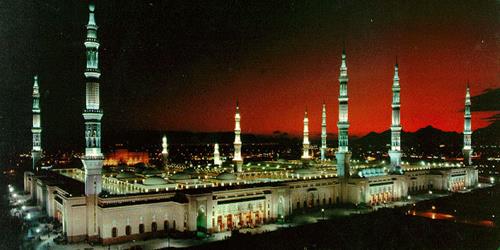
Magnificent View of The Prophet's Mosque
To
visit Madinah is not a Hajj or Umrah rite, but the unique merits of the
Prophet’s city, his Mosque and his sacred tomb attract every pilgrim to
visit it. There is no Ihram nor talbiyah for the visit to Madinah or the
Prophet’s Mosque.
Unique Merit of the Prophet’s Mosque. The
Prophet (peace be upon him) himself participated in the construction of
this mosque, called it "My Mosque" and led prayers in it for years. He
has also said that a salah performed in the Prophet’s Mosque is
better than a thousand salats in any other place except Masjid
al-Haram in Makkah.
According to Hazrat Anas, the Prophet (peace be upon him) has also said:
"The person who offers 40 prayers consecutively in my Mosque, without
missing a prayer in between, will secure immunity from the fire of Hell
and other torments and also from hypocrisy." (Musnad
Ahmad)
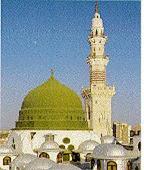
Visiting the Holy Tomb. It
is a great privilege for the pilgrims to visit our beloved Prophet’s
tomb. The Prophet (peace be upon him) once said:
1.
Travel to Madinah and Niyyah. When
you start travel to Madinah, Make niyyah (intention) as such:
" O Allah! I start journey to visit the holy tomb of Prophet Muhammad
(peace be upon him). Please accept it from me."
During this journey, recite Darud Sharif frequently. When the city of
Madinah is in sight, show your extreme fondness and excitement and
humbly enter the city while reciting Darud and Salam.
2.
Masjid-e-Nabvi. After
putting your luggage at your residence, take a bath or perform
ablutions (vudu), wear nice dress, apply perfume and proceed
towards the Prophet’s Mosque while uttering Darud.
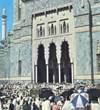
3.
Bab-e-Jibril. Enter
the mosque through Bab-e-Jibril or Bab-us-Salaam or if this is not
possible, enter through any other door.
4.
Right Foot. Place
your right foot first in the entrance, praise Allah (such as say Allhu
Akbar, Subhan Allah, Alhamdu Lillah, etc.), recite Darud and
say:
"Allah humma aftah li abwabe rahamte ka"
5.
Two Raka’t Nafl. If
it is not undesirable (Makrooh) time, offer two rakahs of nafl tahiyyat
al-masjid (greeting of the masjid) preferably in Riaz al-Jannah near
the tomb of the Prophet or otherwise anywhere else in the mosque.
6.
In front of the Holy Tomb.
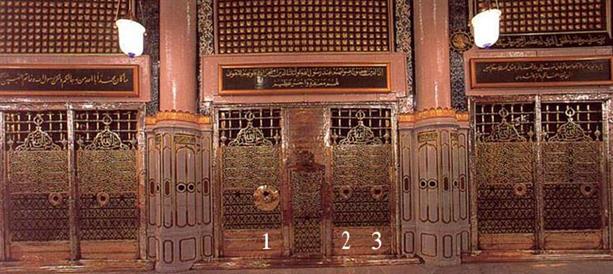
8.
In front of the sacred tomb of The Holy Prophet (peace be upon him),
there are three sections of brass screens and all three have holes in
them. Look at the picture carefully. If you stand in front of the middle
section between the pillars, you'll see a big round hole on your left.
This is in front of the face of the Holy Prophet. Adjacent to it is a
door that stays closed. Right after it on the right side is a round hole
which is in front of the face of Hadrat Abu Bakr Siddique. On the right
of it, there is another round hole which is in front of the face of
Hadrat Umar Farooq.
9.
Offer Salam of others. Now
offer salam of relatives or friends in your own language or say:
"Asslamu alaika ya Rasul Allah min----."
After the word "min", add the name of your friend or relative.
10.
Salam on Hazrat Abu Bakr Siddique. Then
move a little to the right and stand before the grave of Hazrat Abu Bakr
(may Allah be pleased with him). Greet him and supplicate to bestow His
mercy and forgiveness on him.
11.
Salam on Hazrat Umar Farooq. Again
move a little to the right before the grave of Hazrat Umar ( may Allah
be pleased with him), and greet him and make supplication for him.
12.
Forty Prayers. Men
should offer forty prayers (Salat) in the Prophet's Mosque, but
it is not a requirement of any kind. It is only Mustahab, i.e.,
rewarding if done, but if not done there is no sin.
13.
Other places to visit. Some
of the other important places to visit are: Masjid Quba, Jannat
al-Baqee, graves of Hazrat Hamzah and other
14.
Departure from Madinah. When
you have to leave Madinah, offer your Salam again
to the Prophet (peace be upon him), cry at this separation, supplicate
to Allah and leave with the earnest desire to come back. Excerpted, from: http://www.hajjumrahguide.com/hajj_stepbystep.html
Pilgrimage (Hajj): The Fifth Pillar of Islam - Waleed Abdul-Hakeem on
TheDeenshow
https://www.youtube.com/watch?v=hWWmINiLCAk
The Islamic Pilgrimage To Mecca Explained
https://www.youtube.com/watch?v=29HpUaJpwvI
How to Perform Umrah
https://www.youtube.com/watch?v=oD05wpT48bM
How to Perform Hajj-Step By Step Hajj Guide
https://www.youtube.com/watch?v=Hb-ngN7pVyw
https://www.youtube.com/watch?v=HXULW_vHE18
Hajj: An Easy Step by Step Guide - Abdul-QaadirBaksh
https://www.youtube.com/watch?v=bE-LnWg4yrU
Jamarat (three pillars) – The Hajj Ritual of Stoning the Shaytan
https://www.youtube.com/watch?v=-dEthkWOycs
Learn how to wear Ihram in hajj&umrah
https://www.youtube.com/watch?v=lruA--rvlv0
Why Do Muslims Perform Pilgrimage (Hajj) ᴴᴰ
https://www.youtube.com/watch?v=1jkpghiglue
US TV News Converted American Muslims Hajj Duty
http://www.youtube.com/watch?v=BOvyGtKu00Q
One American's Pilgrimage To Mecca (Michael Wolfe) Part 1/2
http://www.youtube.com/watch?v=7dOlGoiGrSA
One American's Pilgrimage To Mecca (Michael Wolfe) Part 2/2
http://www.youtube.com/watch?v=Pv_BPa12xZE
Is the father-in-law a mahram?
https://www.youtube.com/watch?v=16wal9PUttM
Can a woman go to Hajj without a male mahram
|
Important Links |
|||||||||||||||||||||||||||||||||||||||||||||||||||||||||||||||||||||||||||||||||||||||||||||||||||||||||||||||||||||||||||||||||